WRAP Certification in Turkey: Complete Guide for Manufacturers
Introduction
Turkey is one of the world's most powerful textile and apparel manufacturing nations. With annual apparel exports making Turkey the 5th largest textile exporter globally, Turkish factories face one of the most competitive and compliance-driven sourcing environments in the world. International buyers, especially from the United States, Germany, the United Kingdom, and France, are no longer satisfied with price and speed alone. They demand proof of ethical production. They want social compliance documentation. And increasingly, they want WRAP certification.
If you own or manage a garment, footwear, or textile factory in Turkey, this comprehensive guide answers every important question: What is WRAP certification? Why does it matter for Turkey? How do you get it? And how does GSCS Turkey support you through the entire process?
What Is WRAP Certification?
WRAP stands for Worldwide Responsible Accredited Production. It is the largest independent social compliance certification program in the world for factories that produce apparel, footwear, and sewn products. Founded in 2000 and headquartered in Arlington, Virginia, USA, WRAP's core mission is to promote safe, lawful, humane, and ethical manufacturing across the global supply chain.
WRAP issues three levels of certification:
Platinum: highest level, valid for two years
Gold: full compliance, valid for one year
Silver: conditional compliance, valid for six months
For Turkish factories, achieving Gold or Platinum status signals to international buyers that your facility operates at the highest standard of ethical and legal compliance.
Importance of WRAP Certification in Turkey's Textile Industry
Turkey plays an important role in global clothing supply chains as the EU's second-largest supplier of textiles, third-largest supplier of clothing, and the source of 16% of all EU textile imports. The country employs 1.2 million workers in the textile and clothing industry.
Turkish factories have reason to be proud of this, but Turkish factories have experienced (or faced) increased pressure recently. In March 2024, Istanbul's Apparel Exporters' Association (İHKİB) announced its first official partnership with WRAP in order to support Turkish companies in the US market by providing support with certifications. The focus will be on training for certifications. The message is clear: WRAP certification is a requirement for Turkish exporters aiming for the US market.
The following list mentions the reasons why WRAP certification for Turkey's exporters may be considered a requirement:
Entry into the US Market: WRAP certification is adequate proof for responsible sourcing by over 700 global brands and retailers. Turkey is the third largest exporter of textiles to the US, and for Turkey-bound US textiles, achieving WRAP Gold certification is becoming a baseline requirement.
European Union Buyers' Expectations: The EU Corporate Sustainability Due Diligence Directive (CSDDD) is accelerating the EU fashion brands' supply chain and ESG due diligence, and as a result, Turkish-sourced brands are increasingly expected to demonstrate compliance.
Knowing how to compete: Turkey's apparel industry is expected to see a 4.47% decline in exports in 2024 due to increased competition from textiles sourced in Bangladesh and China. Unlike its competitors, Turkish WRAP-certified factories are the least risky sourcing factories for buyers.
Audit Consolidation: WRAP certification is recognized by 700+ global brands. Thus, a single WRAP certification can substitute numerous brand-specific audits, allowing factories to save valuable time and financial resources.
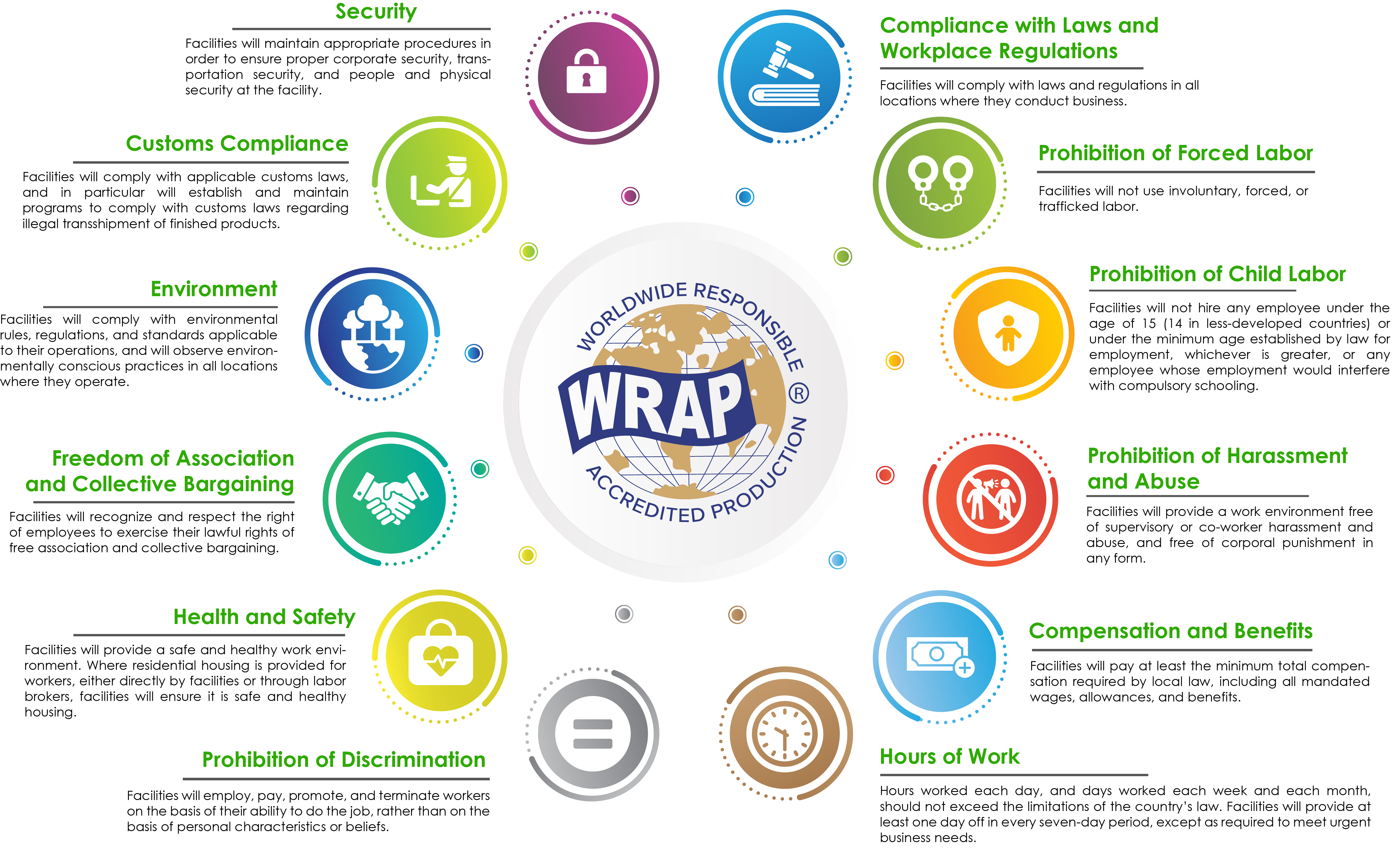
The 12 Principles of WRAP Certification
Every WRAP audit evaluates a factory against 12 core compliance principles. Turkish factories must demonstrate full adherence to each:
| Principle | What It Covers |
| No Child Labor | Workers must meet Turkish legal minimum age requirements |
| No Forced Labor | All employment must be entirely voluntary |
| No Harassment or Abuse | Workers must be treated with dignity and respect |
| Compensation & Benefits | Wages must meet or exceed Turkish Labor Law minimums |
| Hours of Work | Working hours must comply with Turkish İş Kanunu regulations |
| Non-Discrimination | Equal opportunity for all workers regardless of background |
| Health & Safety | Safe, healthy working environment must be maintained |
| Freedom of Association | Workers can join associations and unions freely |
| Environment | Full compliance with Turkish environmental regulations |
| Customs Compliance | Legal import and export practices must be followed |
| Security | Protection against smuggling and unauthorized activities |
| Management Systems | Documented policies and internal monitoring systems |
These principles align closely with Turkish Labor Law, the Turkish Occupational Health and Safety Law (İSG Kanunu No. 6331), and the relevant conventions of the International Labour Organization (ILO).
Benefits of WRAP Certification for Turkish Garment Factories
Open the US market.
Of Turkey's garment exports, those to the United States are among the most valuable, and American buyers are among Turkey's most important customers. The majority of the bigger American apparel companies will only buy from WRAP-certified factories. With a WRAP Gold or Platinum certification, Turkish factories will have their first entrance to the marketplace with an established reputation.
Reduce Audit Fatigue
Turkish factories without WRAP certification end up with many smaller audits from the different brand compliance teams, using time and resources that could be spent more effectively. Receiving WRAP certification significantly reduces this burden, as more than 700 brands recognize it.
C-TPAT Alignment
The WRAP certification is aligned with the Customs-Trade Partnership Against Terrorism (C-TPAT) of the US Customs program. Usually, WRAP certification is sufficient for C-TPAT compliance, and this certification reduces the risk of customs delays and improves the import of goods into the US.
Improve Worker Retention and Productivity
Turkish garment factories that implement WRAP principles with better working conditions and compensation also improve productivity and output, all while having less employee turnover. In Turkey's present labor environment, this retention of garment workers directly improves productivity and output, all while having less employee turnover.
Build Long-Term Brand Trust
Turkish factories that become WRAP-certified gain a natural place on the WRAP registry, where they are visible to a variety of important global stakeholders, including buyers, NGOs, and brands, as well as members of the press. This level of transparency multiplies different trust scenarios and positions Turkish factories as dependable and honest partners in the manufacturing space.
Get Ready for EU Sustainability Laws
The EU is tightening enforcement for Corporate Sustainability Due Diligence Directives and responsible sourcing regulations. WRAP certification gives EU buyers a documented foundation for compliance and meets the requirements for Turkish factories.
WRAP Certification Cost in Turkey
The cost of WRAP certification in Turkey varies depending on factory size, number of employees, production complexity, and current compliance maturity. The following table provides realistic cost estimates:
| Factory Size | Estimated Total Cost | Notes |
| Small Factory (50–150 workers) | $2,500 – $4,500 | Basic audit, documentation review |
| Medium Factory (150–500 workers) | $4,500 – $9,000 | More detailed audit, multi-department review |
| Large Factory (500+ workers) | $9,000 – $16,000+ | Complex audit, possibly multi-day |
Note: Costs include WRAP registration fees, auditing fees, and preparation support. Costs may vary based on location within Turkey, audit findings, and the extent of CAP remediation required.
How GSCS Turkey Supports WRAP Certification in Turkey
GSCS Turkey is a globally recognized auditing, certification, and inspection body with established operations across Turkey. As a WRAP-approved auditing firm, GSCS Turkey provides end-to-end support for Turkish garment and textile factories seeking WRAP certification:
Pre-Audit Gap Assessment: Identifies compliance gaps prior to the formal audit so factories can be proactive in addressing potential issues.
WRAP Third-Party Audits: Audits are conducted by APSCA-registered and WRAP-certified auditors who have knowledge of WRAP and Turkish labor law.
CAP Development Support: Guidance in the development of Corrective Action Plans (CAPs) that meet the requirements of WRAP.
Staff Training: Training of factory management and compliance staff on the principles of WRAP and compliance with Turkish Labor Law, as well as sustainable compliance.
Recertification Management: Support to maintain Gold or Platinum status during annual/biennial recertification.
GSCS Turkey is a reliable and trusted partner in the pursuit of WRAP certification, whether it is the factory’s first or the renewal of an existing certification.
Conclusion
Turkey's textile industry is now competitive, especially since exporting countries are using cheaper labor to manufacture garments. But, for Turkish manufacturing, legally ethical production can be a key differentiator. WRAP certification can be a marketing advantage, build customer loyalty, and contribute to growing a business.
Factories get WRAP Gold or Platinum certification if they manufacture legally, ethically, and transparently. The İHKİB and WRAP partnership indicates that in 2024, WRAP certification will become a requirement for exporting Turkish products.
GSCS Turkey offers end-to-end services, such as gap assessments, audits, certification, training, recertification, and more.
To be the first in your industry to gain an advantage in the global market, reach out to GSCS Turkey today.
Frequently Asked Questions
WRAP certification in Turkey is an internationally recognized social compliance certification that confirms a Turkish garment, textile, or footwear factory operates according to ethical labor practices, safe working conditions, and applicable legal requirements.
Any Turkish factory producing apparel, footwear, sewn goods, or related textile products that exports to the United States, EU, or works with international fashion brands should strongly consider WRAP certification. It is effectively required by most major US retailers.
The full process typically takes between 4 and 10 weeks from application to certificate issuance, depending on the factory's existing compliance level and how quickly corrective actions are completed.
Costs generally range from $2,500 to $16,000+, depending on factory size, audit complexity, and compliance readiness. Contact GSCS Turkey for a specific quote.
Yes. While WRAP is especially dominant with US buyers, it is increasingly accepted by European brands as evidence of ethical manufacturing. It also supports compliance with emerging EU due diligence legislation.
Yes. GSCS Turkey is a WRAP-approved auditing body with experienced, APSCA-registered auditors operating in Turkey. Contact us to schedule a gap assessment or formal WRAP audit.