How to Get WRAP Certification in Indonesia | Complete Guide for Garment Factories
Introduction
Indonesia’s garment and textile industry has become one of the most important manufacturing sectors in Southeast Asia. From large-scale apparel factories in Jakarta and Bandung to export-focused textile manufacturers across the country, Indonesian businesses are increasingly supplying products to global fashion brands and international retailers.
But over the last few years, something major has changed in the global sourcing market.
International buyers are no longer selecting suppliers based only on price and production capacity. Today, global brands want transparency, ethical manufacturing, worker safety, and responsible factory operations. They want proof that the factories they work with follow internationally accepted labour and compliance standards.
This is exactly why Worldwide Responsible Accredited Production (WRAP) certification has become increasingly important in Indonesia.
For Indonesian garment factories and textile manufacturers, WRAP certification is no longer just a “nice-to-have” compliance badge. It is now frequently a prerequisite for joining international supply chains and establishing enduring connections with foreign consumers.
What is WRAP certification?
Worldwide Responsible Accredited Production (WRAP) is a social compliance certification program for manufacturers that produce clothing and sewing goods, including footwear. Founded in 2000 and based in Arlington, Virginia, WRAP promotes safe, lawful, humane, and ethical manufacturing throughout the world.
WRAP goes beyond most buyer-specific audit certifications by obtaining the acceptance of over 700 global buyers, brands, and retailers. So, a WRAP certification can mean no more repeated and disruptive audits or inspections for the factory.
Industries that WRAP certifies include:
- Garments
- Textiles
- Footwear
- Apparel
- Sewn products
- Fashion supply chains
WRAP is a process and factory certification programme. WRAP focuses on the factory's operational processes and the ethical and legal treatment of its employees. They also assess if the factory is legally compliant with norms and standards.
Why WRAP Certification is Becoming Essential in Indonesia
Indonesia's total textile and garment industry value is about USD 13.83 billion, employing over 3.5 million workers. This number makes Indonesia's textile and garment sector one of the biggest manufacturing industries in Indonesia. This sector is one of the largest exporters. Exports of textiles and garments account for around 4.5% of Indonesia's total exports. Major production occurs in the largest island in Indonesia, Java, and its provinces, West Java, Central Java, and East Java.
The last ten years have seen Indonesia as a major destination for sourcing among global fashion and apparel markets. Buyers from Europe, the US, and Australia focus solely on sourcing garments and shoes from Indonesian factories.
However, the global standards in sourcing have changed.
Today, brands are under pressure from the following:
- Consumers
- Governments
- Sustainability organisations
- Investors
They must demonstrate that their products originate from ethical factories and adhere to compliance standards.
As a result, many international buyers now require suppliers to hold certifications such as WRAP before approving production partnerships.
This means Indonesian factories that fail to get such compliance certifications will find it very difficult to compete in the global market.
WRAP certification offers Indonesian factories a chance to:
- Build buyer trust
- Improve factory credibility
- Increase export opportunities
- Strengthen operational standards
- Reduce compliance risks
- From buyers’ perspective, certification makes factories reliable and long-term sourcing partners.
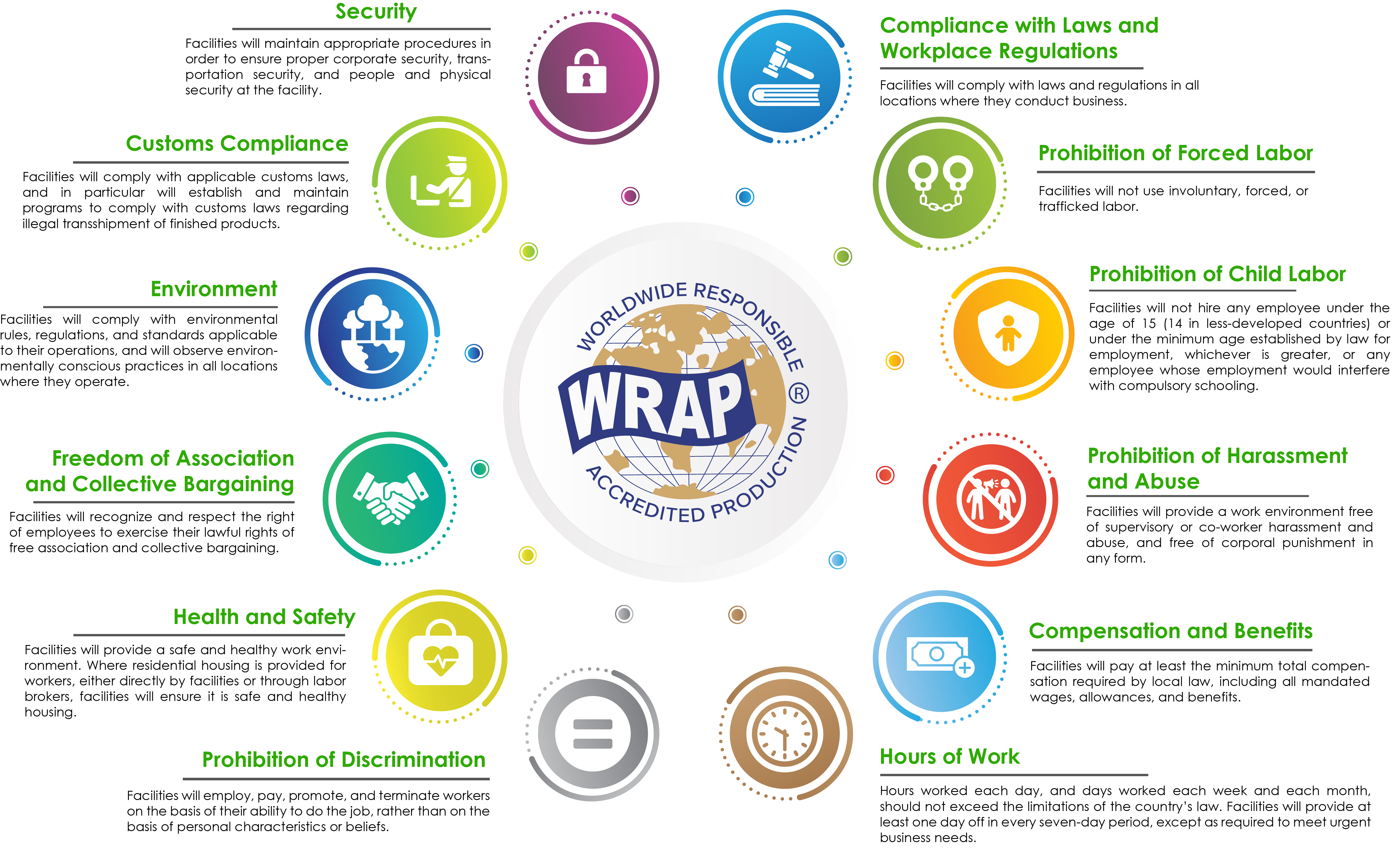
12 Principles Of WRAP Certification
The 12 principles of WRAP certification drive an ethical framework to judge and rate factories. When auditors conduct factory audits in Indonesia, the auditors examine both international levels of compliance and the local labour laws of Indonesia.
1. No Child Labour: Under Indonesian law, only those of the appropriate age are allowed as employees at the factory. Factories are responsible for maintaining compliance with these laws and keeping proper records.
2. No Forced Labour: Employment must never be mandatory. Factories have no authority to utilise any bonded labour or remove the freedom of their respective employees.
3. No Harassment or Abuse: Physical assaults or verbal abuse, in either case, is unequivocally intolerable.
4. Compensations & Benefits: Regional labour laws and policies, such as Indonesia’s Minimum Wage Law, must be observed and complied with.
5. Hours of Work: The Indonesian labour law must also be observed in regard to work hours and breaks.
6. Non-Discrimination: Discrimination in recruitment and similar cases is not permitted.
7. Health & Safety: Fire safety, emergency exits, and protective equipment must be provided and maintained.
8. Freedom of Association: All workers should have the right to unionise and organise to facilitate communication in the workplace. No threats and no acts of discrimination should be tolerated.
9. Environment: Factories and industries should comply with the laws and regulations set when it comes to the disposal of waste, effluent, and chemicals when handling to avoid pollution.
10. Customs Compliance: To avoid customs violations, smuggling, illegal trade and incorrect declaration, movement of goods should be properly documented and conducted, sanctioned by law.
11. Security: Factories should employ necessary preventive measures to protect goods, the premises, and the entire supply chain from theft, unauthorised access, and tampering.
12. Management Systems: Factories should maintain long-term ethical operations by writing compliance policies, training employees, and engaging in frequent self-assessment.
How WRAP Certification Improves Global Buyer Relationships
One thing many factories underestimate is how important trust is in international sourcing.
Buyers want consistency. They want predictability. Above all, they seek assurance that unethical manufacturing practices won't harm their brand reputation.
When a factory is WRAP certified, it sends a strong signal:
"This factory has been independently audited and verified.”
That single factor can significantly improve communication with buyers, simplify onboarding processes, and increase the likelihood of securing repeat orders.
In highly competitive markets like Indonesia, trust often becomes the deciding factor between two similar suppliers.
Key Benefits of WRAP Certification for Indonesian Manufacturers
From a business perspective, WRAP certification delivers far more than compliance. It creates measurable commercial advantages that directly impact growth and export potential.
Below is a simplified overview:
| Business Area | Impact of WRAP Certification |
| Export Growth | Improves access to international markets |
| Buyer Trust | Builds confidence with global brands |
| Factory Reputation | Enhances credibility and professionalism |
| Risk Reduction | Minimizes compliance-related issues |
| Worker Confidence | Improves workplace environment |
| Competitive Positioning | Differentiates factory from competitors |
In practical terms, WRAP certification helps Indonesian factories move from being just another supplier to becoming a trusted manufacturing partner.
The WRAP Certification Process in Indonesia
The certification process is the same for everyone. Knowing what you're looking for makes it easier to avoid lengthy certifications that require repetition.
Step 1: Create an Account on the WRAP Compliance Portal
The factory goes to the WRAP compliance portal at wrapcompliance.org and fills out the form for registration on the portal. Starting in 2024, the costs to register are:
- Factories with 100 or fewer workers: 650 USD
- Factories with 101–200 workers: 950 USD
- Factories with 201–1,000 workers: 1,350 USD
- Factories with 1,001 or more workers: 1,550 USD
- This payment goes to WRAP and is different from the audit payment.
Step 2: Fill out the Self-Assessment Questionnaire
WRAP must conduct an internal evaluation before an outside auditor can visit the factory. This evaluation consists of a questionnaire that goes over the 12 guiding principles of WRAP. This is an opportunity for the factory to identify any areas within the factory that lack the necessary documentation, policies, or practices that are deemed necessary in the formal audit. The gaps need to be filled before the WRAP auditor comes, not while they are there.
Many factories in Indonesia do not prepare for audits and skip step one of the process. After the formal audits, a long list of corrective actions must be taken.
Step 3: Choose a WRAP-approved auditing company.
WRAP maintains a list of approved third-party monitoring companies that can conduct WRAP audits. GSCS Indonesia is one of the WRAP-approved companies and has been doing social compliance auditing in Indonesia and the rest of Southeast Asia for a long time.
Picking the right auditing partner is crucial for factories. An auditor who understands local labour laws in Indonesia, especially UU Ketenagakerjaan No. 13/2003 and Ministry of Manpower Regulation No. 60 of 2016, about the new wage rules and safety regulations, can give a factory helpful feedback that goes beyond a simple list of things to do or not do.
Step 4: On-Site Audit
The duration of the audit is determined by the size of the factory, but it typically lasts one or two days. During the on-site audit, the GSCS Indonesia audit team will:
- Collect and examine all documentation related to HR, payroll, and policies.
- Review the layout of the production floor, fire exits, storage spaces, and worker amenities.
- Conduct interviews with workers away from their supervisors
- Collect and examine documents
- Review records related to environmental compliance
Interviews with workers are highly important. Auditors interview workers to determine if what the documents describe aligns with the factory's daily practices. Transparent factories with well-established relationships with their workers will usually excel in this regard.
After the audit, the factory is given a report with detailed findings. It is normal for almost all factories, especially if the audit is their first, to have some findings. The factory’s response is most important.
WRAP is supported by a fully developed and detailed Corrective Action Plan, which communicates to WRAP that the factory is serious about compliance and improvement. GSCS Indonesia provides the factory with support for the Corrective Action Plan (CAP) and assists them in devising a correct process to experience the steps, which have practical value and are measurable.
Step 6: Certification Issuance
After WRAP has completed the review and accepted the audit report and CAP, they will issue the certification at one of the three levels:
- Silver: Issued typically at first-time facilities where minor non-conformances are noted, valid for six months
- Gold: While valid for one year, this certification may only be awarded to a factory where full compliance has been demonstrated.
- Platinum: Issued for two years when one factory has achieved three consecutive successful Gold-level audits. This award is the highest recognition WRAP offers.
- The WRAP website will list all certified facilities. Buyers use this certification when they want to confirm that their supplier meets the required compliance.
WRAP Certification Cost in Indonesia
The total cost of obtaining WRAP certification in Indonesia depends on factory size, the complexity of your operations, and your current compliance readiness. Below is a general estimate to help with budgeting:
| Factory Size | Estimated Total Cost Range | Notes |
| Small (up to 150 workers) | USD 2,000 – USD 4,000 | Covers registration, audit fees, and basic preparation support |
| Medium (150–500 workers) | USD 4,000 – USD 8,000 | Multi-line factories with more documentation review |
| Large (500+ workers) | USD 8,000 – USD 15,000+ | Complex operations, multi-day audits, multiple departments |
Why Choose GSCS Indonesia Ltd for WRAP Certification in Indonesia
GSCS Indonesia has the expertise of a WRAP-approved auditing and social compliance company with the ability to operate in all of Southeast Asia, including Indonesia. Our team possesses knowledge of the WRAP standard and the Indonesian laws that factories must comply with, including UU Ketenagakerjaan, regional UMR, Permenaker, safety regulations, and environmental laws.
This is how we assist Indonesian factories with the WRAP certification.
Pre-Audit Gap Assessment – Our team travels to the site and performs a gap assessment of the factory’s documentation, internal policy, and practices prior to the formal audit. From there, we set clear and concise expectations to help the factory achieve a more favourable audit outcome.
Third-Party WRAP Audit: The GSCS Indonesia auditors perform the official WRAP compliance audit and assess all 12 principles against the operations and documents of the factory.
Compliance Action Plan - We translate our audit findings and outline actionable and practical steps for your compliance team.
Workshops: We conduct workshops for line supervisors, HR personnel, and compliance officers to prepare workers for interviews and ensure compliance with WRAP.
Attainment of Certificate – GSCS Indonesia ensures WRAP certification for gold annual renewals and platinum renewals every two years. Continuous compliance is guaranteed to keep certification levels for factories year after year.
Conclusion
WRAP certification is no longer just a compliance requirement—it has become a strategic advantage for Indonesian garment and textile manufacturers.
In a sourcing environment driven by transparency, accountability, and ethical production, certification helps factories:
Build global credibility
Improve buyer relationships
Increase export opportunities
Strengthen operational systems
For Indonesian manufacturers aiming to compete internationally, WRAP certification is not simply about meeting standards. It is about proving reliability in a market where trust matters more than ever.
Frequently Asked Questions
Any garment, footwear, or textile factory in Indonesia that exports to or seeks contracts with international brands, particularly those in the US, EU, Japan, or Australia, should consider WRAP certification. It is especially important for factories targeting large retail buyers.
From initial registration to certificate issuance, the process typically takes 4 to 8 weeks, depending on how prepared the factory is at the start and how quickly the CAP is approved by WRAP.
WRAP is not required by Indonesian law. However, many international buyers treat it as a condition of doing business. For factories targeting US retailers in particular, it is effectively mandatory.
Gold certification is valid for one year and is awarded when a factory meets all WRAP compliance requirements. Platinum is valid for two years and is only awarded after three consecutive successful gold-level audits; it signals the highest level of sustained compliance.
Factories must complete compliance preparation, undergo audits, and meet WRAP ethical manufacturing standards.