GSCS Indonesia SMETA Audit Services for Garment & Textile Industry
Introduction
Over the last few years, I’ve noticed a major shift in how international brands choose their suppliers. It’s no longer only about pricing, production speed, or manufacturing capacity. Today, global buyers want something with deeper confidence.
They want confidence that the factories they work with operate ethically, treat workers fairly, maintain safe working environments, and follow responsible business practices.
For manufacturers in Indonesia, especially in the garment, textile, footwear, and export sectors, this shift has changed the rules of global sourcing.
That’s precisely why the Sedex Members Ethical Trade Audit (SMETA) has become increasingly important.
SMETA is now one of the most recognised ethical audit systems, used by global brands to evaluate factories and suppliers. Often, buyers expect factories to complete SMETA audits before approving long-term sourcing partnerships.
For Indonesian manufacturers looking to expand globally, improve buyer trust, and strengthen compliance standards, SMETA is no longer just an audit; it has become a strategic business advantage.
What is a SMETA audit?
SMETA stands for Sedex Members Ethical Trade Audit. Sedex is a non-profit organisation that works to improve businesses and provides the most common social audit methodology. Using SMETA auditing helps Sedex to support businesses in assessing their supply chain with responsible practices.
SMETA audits are not like quality inspections. SMETA audits do not focus on the product itself. SMETA audits focus on the people. The audit includes the employees and how they are treated and paid and if they are able to work in safe conditions. Ultimately, it helps assess if there is a lack of ethics in a business.
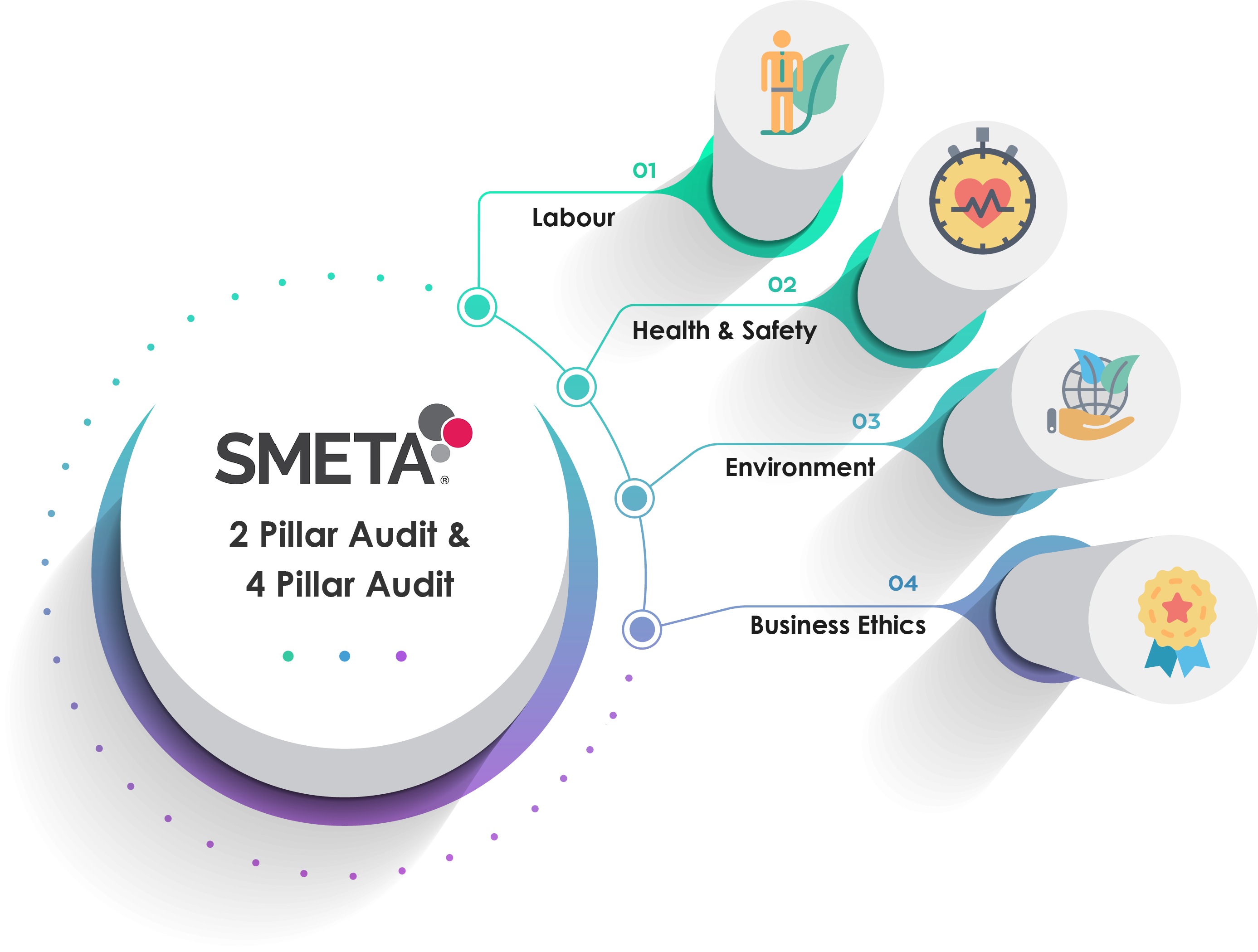
There are four areas, called the Four Pillars, that are being assessed.
- Labour Standards – wages, working time, constraining child labour, forced labour, freedom to associate, and non-discrimination
- Health & Safety – emergency response to fires, exit routes, PPE, machinery safety, worker support
- Environment – energy, waste, control of pollution, regulatory compliance concerning the environment
- Business Ethics – practices in data protection, acts of corruption, acts of bribery, and integrity
If an audit covers only two pillars, it will only assess health, safety, and labour standards. If an audit covers all four pillars, it is called a "four-pillar audit.". Most of the big brands request a SMETA audit in the 4-pillar version. Brands located in Europe, North America, and the United Kingdom particularly request the 4-pillar version.
Why Indonesian Factories Need SMETA Audits Right Now
Indonesia has one of the largest and most rapidly growing garment and textile industries in Southeast Asia, with over 3.5 million employees working predominantly in West, Central, and East Java. Textile and clothing exports account for around four and a half per cent of Indonesia's national exports. Factories in Indonesia support some of the biggest clothing brands in the world.
The global sourcing landscape has changed over recent years. Buyers are now denying orders simply based on a factory invitation or a self-written declaration. Buyers want proof, in the form of documents, that their Indonesian suppliers are compliant with ethical trade practices.
There are several dimensions in play here:
The EU Corporate Sustainability Due Diligence Directive (CSDDD) — European companies are now legally required to identify and address human rights and environmental risks across their supply chains. Companies that buy from Indonesian factories are now compelled to ensure compliance with this regulation, and having a valid 4-Pillar SMETA audit is perhaps the most effective way to do so.
Retailers in the US and the UK – it's a requirement from the major retailers, including Walmart, H&M, ASOS, Marks & Spencer, and Primark, for manufacturers in Indonesia to have up-to-date SMETA audit reports. Contract negotiations remain stagnant at the compliance level without a valid SMETA audit.
SMETA 7.0 Updates — Sedex launched the 2024 version of SMETA, the first change in the auditing system in years. One of the most significant components of SMETA 7.0 is the introduction of the Management Systems Assessment (MSA). This stipulates that auditors will determine not just if there are policies in place but also if management systems in factories are in fact capable of supporting ongoing compliance. SMETA versions prior to 7.0 required less work on behalf of the factories, specifically SMETA 6.0 and earlier versions.
If you want to cultivate better relationships with your international buyers in 2026 and beyond, there is no better time than now to get SMETA ready. Waiting until a buyer has placed your account on hold is too late.
SMETA Audit is Becoming Essential in Indonesia
Indonesia has become one of Southeast Asia’s most important manufacturing hubs. From garments and textiles to footwear and consumer goods, Indonesian factories supply products to some of the world’s biggest brands.
But global sourcing standards are changing rapidly.
International retailers and fashion brands are under increasing pressure from:
- Consumers
- Investors
- Governments
- Sustainability organisations
They must prove that their products are sourced responsibly.
As a result, brands now expect suppliers to demonstrate:
- Ethical labour practices
- Safe working environments
- Compliance with labour laws
- Transparent operational systems
This area is where SMETA plays a critical role.
For Indonesian factories, SMETA audits help the following:
- Improve international credibility
- Meet buyer compliance requirements
- Reduce supply chain risks
- Increase export competitiveness
- Build long-term sourcing relationships
Often, factories with strong compliance systems gain access to better buyers and more stable contracts.
Understanding the Difference Between 2-Pillar and 4-Pillar SMETA
The distinction between 2-Pillar and 4-Pillar SMETA audits often puzzles many factories.
The correct choice depends on the buyer’s criteria and how stringent the supply chain compliance controls are.
2-Pillar SMETA
The focus of the 2-Pillar audit is on:
- Labour Standards
- Health & Safety
This version is most often used when buyers want to assess workers and the safety systems at the workplace.
4-Pillar SMETA
The 4-pillar audit includes everything from the 2-pillar audit and also covers:
- Environmental Assessment
- Business Ethics
Many global brands that prioritise sustainability and responsible sourcing often prefer this more extensive version.
Benefits of a SMETA Audit for Indonesian Businesses
SMETA audits are becoming increasingly valuable for businesses in Indonesia as international buyers focus more on ethical sourcing and responsible manufacturing. For garment factories, textile manufacturers, and export-orientated companies, SMETA helps strengthen credibility, improve compliance standards, and build long-term trust with global brands.
Beyond meeting buyer requirements, SMETA audits also help Indonesian businesses improve internal operations, reduce compliance risks, and position themselves as reliable partners in competitive international supply chains.
| Benefit Area | How SMETA Helps Indonesia Businesses |
| Global Buyer Trust | Demonstrates ethical manufacturing practices and increases confidence among international buyers and sourcing partners. |
| Export Market Access | Helps factories meet compliance requirements for global apparel, textile, and footwear brands. |
| Improved Factory Reputation | Positions businesses as responsible and professionally managed manufacturers in Indonesia. |
| Better Workplace Standards | Encourages improvements in worker safety, labor conditions, and factory management systems. |
| Reduced Compliance Risks | Identifies operational gaps early and helps prevent labor or safety-related issues. |
| Competitive Advantage | Gives factories a stronger position when competing for international sourcing opportunities. |
| Supply Chain Transparency | Improves visibility and accountability across manufacturing operations and supplier management. |
| Long-Term Business Growth | Builds stronger relationships with global brands looking for reliable and ethical suppliers. |
Industries in Indonesia That Commonly Require SMETA Audits
In Indonesia, SMETA audits are required in most export-based industries, including:
- Garment manufacturing
- Textile production
- Footwear factories
- Apparel exporters
- Consumer goods manufacturing
- Accessories production
- Supply chain manufacturing facilities
SMETA audit services are in high demand and growing in Indonesia's top five most populated cities: Jakarta, Bandung, Surabaya, Tangerang, and Semarang.
The SMETA Audit Process: Step by Step
Understanding the SMETA process allows your compliance team to proactively address issues, reducing the time spent on implementing cumulative corrective actions and ensuring a smooth audit for your factory.
Step 1: Register on the Sedex Platform
For the audit process to start, your factory must have a Sedex supplier account. If your factory's customer is a Sedex member and has initiated the audit, your factory should receive a link to the invitation. Your first time using the platform means that GSCS Indonesia is available to help you throughout the Sedex registration and account creation process.
Step 2: Complete the Self-Assessment Questionnaire (SAQ)
After registration, your factory will have to complete the SAQ on the Sedex platform. The SAQ will need you to answer a number of questions depending on the type of labour, safety, and health systems, as well as the ethics of the management systems that your factory has in place. From 2024, Sedex will be launching an Environmental Self-Assessment Questionnaire (ESAQ) to collect more information and data concerning the environment.
Filling in the SAQ is not just a formality. The SAQ answers show the auditor your factory's risk profile before they arrive. Factories that complete the SAQ thoroughly and in the most honest way possible tend not to have a problem with the audit process and usually have the fewest problems with their audits.
Step 3: Document Preparation
Preparation is everything. Before the GSCS Indonesia audit team examines your factory, you should have the following prepared and organised:
- Employment contracts for all workers, including seasonal and contract staff
- Payroll records documenting actual wages paid and records for minimum wage
- Time and attendance records from the past 12 months
- Please provide fire drill records, emergency response procedures, incident reports, and PPE logs from the health and safety records.
- Environmental permits and records for the disposal of waste
- Anti-bribery and business ethics policies
- Training records for workers and supervisors
GSCS Indonesia offers a document preparation checklist for compliance with Indonesian law specifically the UU Ketenagakerjaan No. 13/2003 (Manpower Law), Permenaker occupational health and safety regulations, and UMP (Upah Minimum Provinsi) wage regulations.
Step 4: On-Site Audit
GSCS Indonesia sends trained auditors to your site for one to two days, depending on the audit scope and the size of the factory. During an audit, the auditor will:
- Complete a full walk-through of production / storage floors, including the canteen, prayer rooms, medical, and emergency areas.
- Go through all the documents submitted during the preparation stage.
- Conduct interviews of the management and HR
- Conduct confidential interviews of the workers, individually and in groups, without management present
The worker interviews are one of the most crucial steps in a SMETA audit. Auditors do these interviews to cross-verify the documented activities with the actual activities carried out on the production floor. SMETA compliant factories will find this part of the audit easy. In contrast, factories that have documented policies but show a significant gap in their implementation will find this part of the audit to be revealing.
As per SMETA 7.0, auditors will also conduct a management systems assessment during the site audit.
Step 5: Uploading the audit to Sedex
After the on-site audit wraps up, GSCS Indonesia spends a few workdays compiling the complete SMETA audit report. This report uploads directly to the Sedex platform, and all your linked buyers can see it immediately. One audit report—shared with every buyer who has requested it. SMETA's most significant benefit is its ability to prevent the exhausting cycle of multiple distinct audits for different brands.
According to Sedex's current policy, audit reports older than 24 months are no longer "robust," and buyers may not accept them. Keeping the timing of your audits in mind makes certain that your report is still valid when buyers review it.
Step 6: Corrective Action Plan (CAP)
A SMETA audit identifies findings at almost all factories (even the best-managed ones). The result is totally acceptable. The purpose of the audit is not to catch the factory out, but to identify opportunities to improve.
For every nonconformance, GSCS Indonesia submits a corrective action plan. Each finding is outlined with a detailed description, root cause, and an action step with a timeframe to complete it. To support you through the CAP, we offer as many follow-up visits as you require to both support your team and ensure that the found non-conformances are closed.
SMETA Audit Cost in Indonesia
Audit costs vary depending on factory size, number of workers, number of production lines, and whether you need a 2-pillar or 4-pillar audit. Below are general estimates to help with planning:
| Factory Size | Estimated Cost Range |
| Small factory (up to 150 workers) | USD 1,500 – USD 3,000 |
| Medium factory (150–500 workers) | USD 3,000 – USD 6,000 |
| Large factory (500+ workers) | USD 6,000 – USD 12,000+ |
These are estimates. Factories with strong existing documentation and compliance systems typically come in at the lower end. Factories with significant gaps in HR records or safety documentation may require additional preparation support before the audit, which affects total cost.
Contact GSCS Indonesia directly for a transparent, personalised quote based on your factory's specific profile.
Why Choose GSCS Indonesia for Your SMETA Audit?
Choosing the right audit partner is not a minor decision. The quality and credibility of your SMETA report depends on it — and so does your relationship with international buyers.
Deep local knowledge: our auditors know Indonesian labour regulations, the wage structures across the regions, and the specific challenges surrounding the operations of factories in Bandung, Semarang, Surabaya, and Jakarta. We know, for example, that a factory located in Central Java is subject to different UMP obligations (regional wage structure) than a factory in West Java, and our audit will take that into account.
Audit Team with Relevant Experience: Our auditors are trained and have years of experience in social compliance across garments, footwear, textiles, and other manufacturing areas within Southeast Asia.
Comprehensive Support : GSCS Indonesia offers continuous support from the Sedex registration to the completing of the audit CAP. Our support is ongoing, and we will not leave you with just a report.
SMETA 7.0 Ready : Our auditors are trained on SMETA 7.0, including the new Management Systems Assessment, which many factories are in the process of adjusting to.
Transparent Communication: We aim to be simple and practical when we explain our findings. We develop our corrective action plans in a manner that enables a compliance team to address the documented issues.
Conclusion
Indonesia's garment and textile industry supplies some of the world's biggest brands — and those brands are under growing pressure from regulators, consumers, and their shareholders to verify that their supply chains are ethical. That pressure comes directly to factory gates in Bandung, Semarang, Surabaya, and everywhere else across the country.
An SMETA audit is the most practical, globally recognised way for Indonesian factories to demonstrate that they operate responsibly. It protects your buyer relationships, reduces the burden of repeated individual audits, and positions your factory as a credible, long-term sourcing partner.
GSCS Indonesia is here to guide you through every step of the process — from Sedex registration to audit completion to corrective action closure. We understand Indonesian factories, Indonesian law, and what international buyers actually look for when they review a SMETA report.
Contact GSCS Indonesia today to schedule an initial consultation and find out exactly what your factory needs to prepare.
Frequently Asked Questions
A SMETA audit is an independent social compliance assessment that evaluates your factory's labour practices, health and safety, environmental management, and business ethics. International buyers require it because it gives them verified, documented confidence that their supply chain meets ethical standards.
The on-site audit typically takes one to two days. The full audit report is usually ready within three to five working days after the site visit.
This depends on your buyer's requirements. European and UK brands generally require the 4-Pillar audit. GSCS Indonesia reviews your buyer's code of conduct to confirm the correct scope before the audit begins.
Under SMETA 7.0, audit reports older than 24 months are no longer considered robust. Most factories schedule a fresh audit every one to two years to keep their report current for buyer requirements.
Yes — this is one of SMETA's most significant advantages. Your report is uploaded to the Sedex platform, where all linked buyers can access it. One audit covers multiple buyer requirements simultaneously.