
C-TPAT Audit in Indonesia | Supply Chain Security for Exporters & Garment Factories
Introduction
Global trade is becoming more security-focused than ever. International buyers, customs authorities, and logistics partners now expect businesses to maintain strong supply chain security standards before products can move smoothly across borders.
For exporters and manufacturers in Indonesia, this shift is especially important.
If your business exports products to the United States or works with international supply chains, you have probably heard about C-TPAT certification. Today, many global buyers and logistics partners prefer working with suppliers that follow internationally recognized security standards.
This scenario is where the C-TPAT audit in Indonesia becomes highly valuable.
Whether you operate a garment factory, logistics company, freight forwarding business, warehouse, or export company, understanding the C-TPAT audit process can help improve your global credibility and strengthen your supply chain security.
The C-TPAT Audit Explained
C-TPAT stands for Customs-Trade Partnership Against Terrorism. It is a program run by U.S. Customs and Border Protection (CBP). The program was started to protect the integrity of supply chains and stop terrorists from using international shipments to enter the U.S.
The goal of the C-TPAT program is to protect the U.S. borders and allow the regulated passage of goods through international border crossings by working with the private sector. Businesses that partner with C-TPAT have to meet international regulatory and safety standards to keep their partnership.
The most critical requirement is the continuous security of the supply chain for C-TPAT. This touches multiple aspects of the business. Those facets include:
- The secure movement of goods
- The security of the business
- Employee security and privacy
- The security of the business and its partners' information
- The vetting of business partners
As the world becomes more complex, buyers take security matters much more seriously and are more confident doing business with C-TPAT-compliant companies.
C-TPAT (Customs Trade Partnership Against Terrorism) is a voluntary initiative developed by U.S. Customs and Border Protection (CBP) to secure the U.S. supply chains and mitigate the risk of goods being secured:
- Cargo tampering
- Smuggling
- Unauthorized access
- Terrorism-related threats
- Supply chain disruptions
- Cargo theft
C-TPAT is less about product certifications and more focused on the operational and logistical security of the supply chains.
The audit reviews procedures that companies use to protect the following:
- Physical facility security
- Cargo handling procedures
- Transportation security
- Access control systems
- Personnel security
- Export documentation
- IT and cybersecurity systems
- Security awareness programs
For exporters from Indonesia, C-TPAT shows that security practices in supply chain management meet globally accepted standards and best practices.
Importance of the C-TPAT Audit in Indonesia
Indonesia is one of the largest Southeast Asian exporters. Among Southeast Asian nations importing to the USA, Indonesia ranks first, with nearly 36% of all USA textile and apparel imports coming from Indonesia. US importers are starting to require C-TPAT compliance for all their suppliers when reviewing contracts with incumbent suppliers from Indonesia.
Exporters from Indonesia have reported the following benefits after achieving C-TPAT compliance.
- Better supply chain security practices
- Reduced risks in supply chain delivery
- Greater global buyer confidence
- Improvement of supply chain delivery time
- Greater business reputation in the international community
To a significant number of Indonesian exporters to the USA, C-TPAT compliance is a necessity, not an option.
Can Indonesian factories get C-TPAT certification?
Most articles on C-TPAT ignore this point. We want our Indonesian friends who own factories to know this: Indonesian factories cannot apply directly for C-TPAT membership or C-TPAT certification.
C-TPAT membership for foreign manufacturers is limited to certain countries and corridors of trade that are recognized by CBP. Indonesia is one of the countries disregarded by the U.S. in determining direct eligibility for specific membership tier processing.
Instead, Indonesian factories get as close to having C-TPAT certification as possible. "C-TPAT-compliant" is not a C-TPAT certification, but it is the recognized framework by CBP in this case. It’s not a formality, nor is it a loophole. It is the standard for compliance for Indonesian manufacturers.
A C-TPAT importer in the U.S. has the obligation to ensure that all foreign suppliers of the U.S. importer, including Indonesian factories, are in compliance with C-TPAT security requirements. The U.S. importer is accountable to CBP and has to show that all the requirements and obligations are fulfilled by:
1. Filling out and submitting the C-TPAT Foreign Manufacturer Security Questionnaire,
2. Undergoing a C-TPAT security compliance audit by an approved auditing firm,
3. Implementing necessary measures to mitigate any identified security risks,
4. Maintaining evidence of continuous compliance.
Although Indonesian factories do not directly own the C-TPAT certificate, if your U.S. importer is C-TPAT certified, you have to be compliant too, and a C-TPAT security audit is the only way to show that compliance.
Industries in Indonesia That Need C-TPAT Audit
C-TPAT is highly relevant for businesses involved in international trade, logistics, and export manufacturing.
Industries commonly implementing C-TPAT security systems in Indonesia include:
| Industry | Importance of C-TPAT |
| Garment Factories | Protects export shipments and improves buyer trust |
| Textile Manufacturers | Strengthens supply chain security for global sourcing |
| Footwear Factories | Supports secure export operations |
| Logistics Companies | Improves cargo and transportation security |
| Freight Forwarders | Reduces shipment handling risks |
| Warehousing Companies | Improves access control and inventory protection |
| Electronics Manufacturers | Enhances export security compliance |
| Consumer Goods Exporters | Strengthens international trade reliability |
Industrial regions such as Jakarta, Bandung, Surabaya, Tangerang, Batam, and Semarang are seeing increasing demand for supply chain security audits and export compliance support.
C-TPAT Compliance Outline for Indonesia
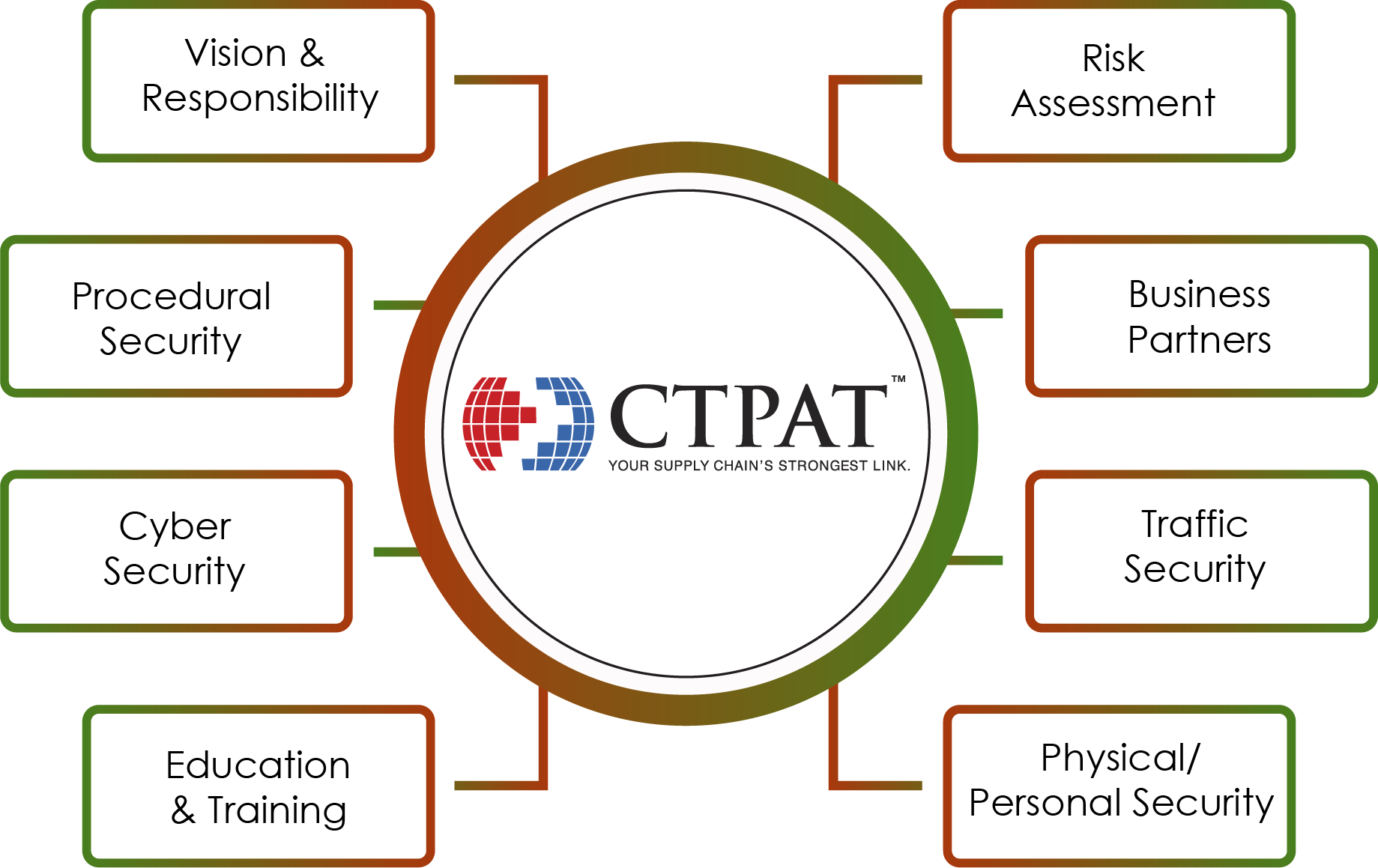
The United States Customs and Border Protection (CBP) has devised minimum security criteria (MSC) checks for all external manufacturers who run trade with the US. The audit mainly centers around the following:
Physical Security
Fencing, bulkheads, locks, lighting, closed-circuit television systems, and cargo control storage systems.
Container & Conveyance Security
Container checks are to be conducted using a 7-point inspection system. Furthermore, high-security container seals conform to the ISO 17712 standard, and the seal numbers for shipments destined to the United States are to be documented.
Personnel Security
Conduct background checks on all employees and visitors who have access to restricted areas, implement controlled employee ID systems, and establish controlled visitor systems.
Access Controls
Restricted access to cargo storage systems, the existence of documented access and egress control systems, and policies and procedures to deny access to unscreened parties.
Cybersecurity
The US maintains control over all systems and data related to cargo, including a system for managing passwords and documented procedures.
Business Partner Vetting
Document procedures to verify the C-TPAT compliance of all US trade partners, including all carriers and freight forwarders and logistics partners.
One primary concern for factories in Indonesia is the container seal process. Per US directives, all containers must have a high-security seal and conform to ISO 17712. Furthermore, the seals must be documented and verified at each and every supply chain handover. This is beyond the typical export documentation requirements.
Benefits of C-TPAT Audit for Indonesia Businesses
As global trade becomes increasingly security-focused, C-TPAT provides both operational and commercial advantages for Indonesian exporters.
| Benefit | Business Impact |
| Improved Buyer Confidence | Builds trust with U.S. importers and international sourcing partners |
| Reduced Cargo Risks | Minimizes theft, tampering, and shipment disruptions |
| Better Customs Credibility | Strengthens export compliance reputation |
| Improved Supply Chain Visibility | Enhances monitoring and operational control |
| Competitive Advantage | Differentiates exporters in global markets |
| Stronger Operational Security | Improves internal security systems |
| Long-Term Business Growth | Supports sustainable export partnerships |
The C-TPAT Audit Process in Indonesia
The C-TPAT audit process generally follows a structured security evaluation framework:
1. Step One: Buyer Request/Questionnaire
The C-TPAT process begins when an importer submits a C-TPAT Foreign Manufacturer Security Questionnaire to your factory. The importer uses the responses to their questionnaire to determine the compliance of your factory and the scope of the audit. The questionnaire includes questions regarding your factory’s physical security, personnel, container security, and your factory’s IT systems.
2. Step Two: Gap Analysis / Pre-Audit Assessment
Your compliance officer will perform a review of your factory’s adherence to the minimum security criteria established by CBP. This is a crucial step in the process because it allows your factory to address security gaps in the time leading up to your factory’s audit. Factories in Indonesia that forgo the gap analysis miss an opportunity to increase their audit preparedness.
3. Step Three: On-Site Security Audit
A one-day security audit will take place at your factory. This audit will cover a multitude of areas. These include the security of your factory’s perimeter, the CCTV system, controls for access to cargo and loading docks, cargo inspection and container seal logs, employee background check and visitor logs, and IT security and supporting documentation.
4. Step Four: Audit Report and Corrective Action Plan
The security auditor will provide a report that contains a corrective action plan (CAP) and supporting documentation outlining the security gaps identified. The report will specify the security requirements, as well as the remediation responsibilities and the due dates for completion.
5. Step Five: Implementation and Re-verification
Once the corrective actions have been implemented, the buyer will typically perform a desk review or a follow-up site assessment to verify compliance. If the buyer is satisfied, your factory will be added to the buyer's list of approved suppliers. To maintain approved compliance, your factory will be subject to a follow-up audit, which will occur at least annually.
Estimated C-TPAT Audit Cost in Indonesia
| Company Size | Estimated Cost | Details |
| Small Business | $2,000 – $4,500 | Suitable for smaller exporters with straightforward operations |
| Medium Company | $4,500 – $9,000 | Includes more detailed audit procedures and compliance evaluations |
| Large Enterprise | $9,000 – $18,000+ | Complex operations, multiple facilities, extensive security assessments |
The cost of a C-TPAT audit in Indonesia varies depending on several important factors:
- Company size and workforce
- Number of warehouses or production facilities
- Existing security systems and infrastructure
- Supply chain complexity and number of logistics partners
- Audit preparation requirements
- Corrective actions and security improvements needed
Why Choose GSCS Indonesia for C-TPAT Audit Support?
Partnering with the right compliance firm is key to a smooth and successful C-TPAT audit. GSCS Indonesia provides specialized C-TPAT audit support to exporters, garment factories, logistics companies, and manufacturers across Indonesia.
Here 's what makes GSCS Indonesia the trusted choice:
- Knowledgeable compliance experts with direct CBP requirements experience
- Hands-on audit preparation support from gap analysis to sign-off
- Extensive knowledge of supply chain security in Indonesian factory environments
- Clear, consistent, and transparent process throughout
- Nationwide coverage across Jakarta, Bandung, Surabaya, Semarang, and Medan
GSCS Indonesia helps companies across the country achieve C-TPAT compliance and strengthen their global trade operations with confidence.
Frequently Asked Questions
A C-TPAT audit in Indonesia evaluates a company's supply chain security practices to ensure they meet the standards required by US Customs and Border Protection for goods entering the United States.
Garment factories, textile manufacturers, footwear producers, logistics companies, freight forwarders, and warehouses exporting to the United States require C-TPAT compliance.
Benefits include faster US customs clearance, reduced shipment delays, lower security risks, stronger buyer confidence, and improved supply chain transparency.
Costs generally range from $2,000 to $18,000 or more depending on company size, number of facilities, and operational complexity.
It helps Indonesian exporters meet US importer security requirements, reduce customs inspection delays, and strengthen long-term buyer relationships.
The full process from gap analysis to compliance verification typically takes three to six months depending on the factory's existing security maturity.