SLCP Verification in Egypt for Garment Factories & Exporters: Complete Guide
Introduction
The global garment and textile industry is evolving rapidly, and international buyers are placing greater emphasis on ethical sourcing, worker welfare, and supply chain transparency than ever before. Today, manufacturers are expected to demonstrate not only product quality but also responsible business practices that align with internationally recognized labor and social standards.
This creates risky competition for textile and garment factories emerging in Egypt, but it can mean great opportunity, too. Egypt is becoming a key market for sourcing textile and apparel products and home furnishings and accessories integrated with fashion and is geographically well-placed to service buyers in Europe, North America, and the Middle East. Nevertheless, a lot of global businesses with textile and garment production lines require their potential suppliers to have recognized social compliance assessments.
The Social & Labor Convergence Program (SLCP) is one of the most accepted frameworks.
In contrast to the social audits that do multiple customer assessments, the SLCP verification in Egypt allows factories to reduce audit fatigue and improve operational efficiency with a common compliance data collection and certification that several customers can use. This strengthens supplier trust with their customers.
It does not matter whether you own a garment, textile, dyeing, washing, embroidery, or accessory manufacturing business; SLCP verification in Egypt can broaden your business's competitive advantage.
This guide aims to instruct the reader on the implications of SLCP verification, the competitive advantages it provides, the verification process, and its importance to manufacturers in Egypt. It will also provide recommendations on how to best prepare your factory for compliance.
What is SLCP verification?
Social & Labour Convergence Program (SLCP) Verification is part of a program that aims to streamline the factory assessment process for evaluating social labor conditions. It was developed as an alternative to existing social labor verification models.
SLCP uses the Converged Assessment Framework (CAF) that enables labour-intensive organisations to gather and submit social labour data that is verifiable and can be shared. Converged assessment frameworks have certified data platforms.
SLCP does not offer a certification. It offers a verification system.
For SLCP to provide organisations with a verification level of service, they require at least one assessment be completed and a verifying individual be approved to review and validate the accuracy of the assessment. A social audit is not needed if the brand or buyer has provided SLCP-verified data.
For organizations interested in SLCP verification, registered and assessed in Egypt, SLCP would be a reasonable and cost-effective alternative to existing social labour verification models.
As of 2025, SLCP has conducted over 10,700 assessments globally, covering approximately 7.5 million workers worldwide. The potential value unlocked through SLCP in 2025 alone was estimated at USD 35 million — resources redirected from duplicative audits toward actual workplace improvements.
2026 Update: SLCP is preparing to launch CAF v2.0, an updated framework designed to align more closely with Human Rights Due Diligence (HRDD) requirements under the EU CSDDD and Germany's LkSG. The update will refine climate data collection, improve guidance for verifiers, and streamline assessment workflows. Egyptian factories planning SLCP verification in the near future should be aware that the next version is coming and factor this into their compliance planning.
How SLCP Verification Benefits Egyptian Exporters
For Egyptian exporters competing in international markets, SLCP verification offers a strategic advantage.
It enables manufacturers to:
- Respond more quickly to buyer requests
- Improve operational efficiency
- Strengthen relationships with global brands
- Reduce duplication of compliance efforts
- Enhance their reputation as ethical manufacturing partners
As more buyers adopt standardized assessment systems, factories with verified SLCP data are better positioned to secure new contracts and expand into additional markets.
Why SLCP Verification is Necessary in Egypt
As international buyers expand their sourcing networks, Egypt's textile and apparel industry is gaining new business prospects. Expanded business opportunities mean increased pressure to address global social compliance concerns.
Growing International Buyer Interest
Leading apparel brands and retailers require suppliers to substantiate their claims relating to labor, safety, and ethics.
In Egypt, SLCP-verified factories can respond to buyers in a more timely manner, as their verified assessment data is already available on one of the major platforms.
This increases buyer trust and makes the supplier onboarding process easier and quicker.
Fostering Growth in the Egyptian Textile Sector
As a result of the high-quality cotton garments, home textiles, and fashion products, Egypt has a competitive advantage.
To be competitive against the likes of Bangladesh, Vietnam, India, and Turkey, factories in Egypt need internationally accepted compliance frameworks.
SLCP Verification allows factories to be competitive and helps with the overall improvement of factory operations.
Improving Market Access
A significant number of international brands prefer suppliers that have completed a social compliance assessment of their choice.
The factories that engage in SLCP verification in Egypt see the following:
- A Faster Qualification Process
- Increased Buyer Confidence
- Access to New Markets
- Improved Relationships with Customers
With a strong focus on ethical and sustainable sourcing and on verified factories, companies gain a sustainable competitive advantage.
Lessening Audit Fatigue
Going through various customer audits every year is one of the primary pain points for manufacturers.
Different buyers might have different audit methodologies, but they might all be asking for the same pieces of information.
SLCP tries to resolve this problem by making data collection uniform.
Factories only have to go through one detailed assessment, and that assessment can then be distributed to different buyers.
This effort saves:
- Assessment-related costs
- Staff workloads
- Production downtimes
- Administrative workloads
Building Trust Through Transparency
Visibility in supply chains has increased in importance.
SLCP verification allows factories to show that there has been verification done of the information related to the following areas:
- Supply chain conditions
- Labour
- Health and safety
- Human resource management
- Management of the facility
For buyers who are sourcing in Egypt, this can create a high level of confidence in the performance of the supplier and can foster long-term business relationships.
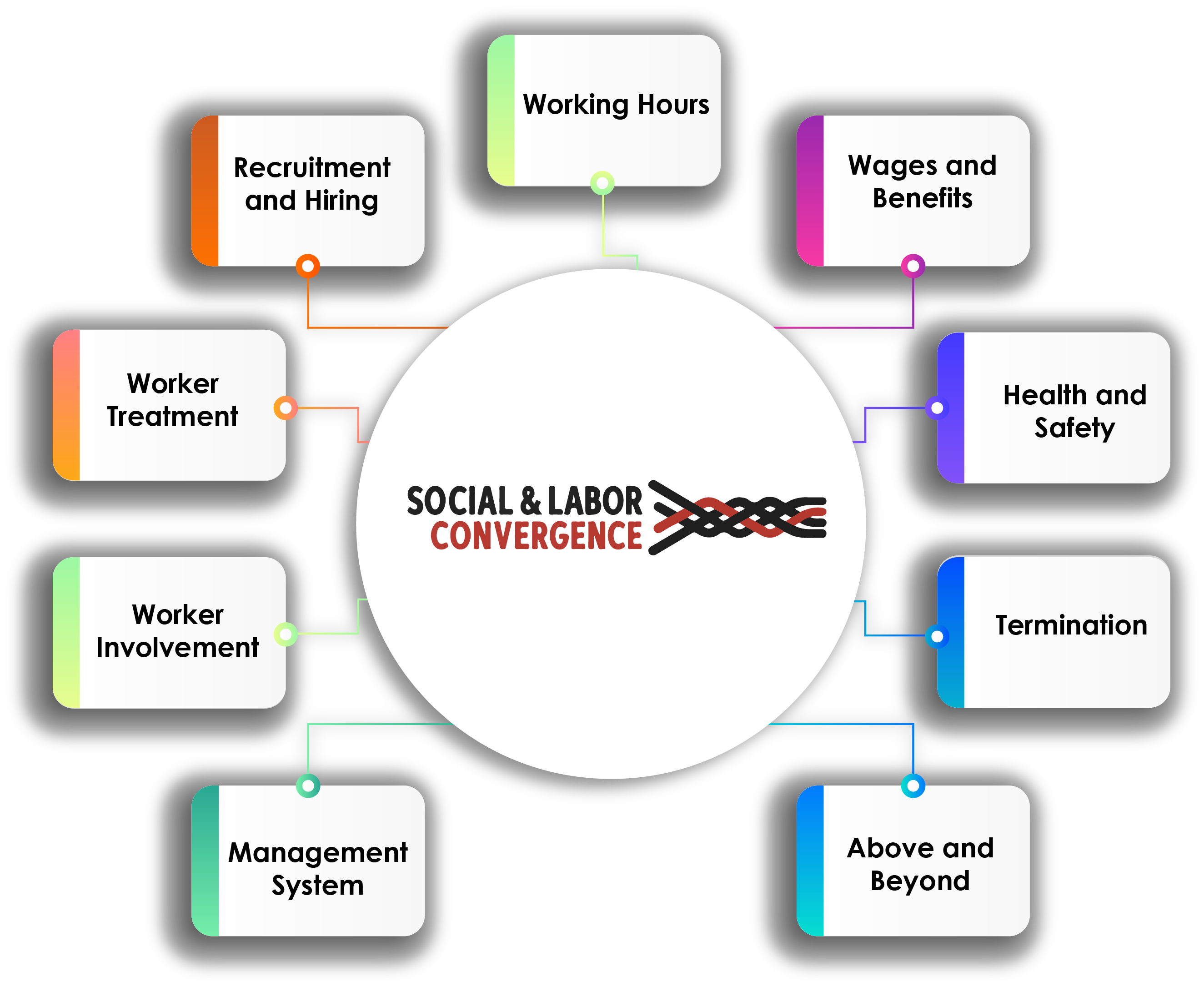
The 9 Modules of the SLCP Converged Assessment Framework (CAF)
The CAF collects data across nine structured modules. Each module asks specific, factual questions about factory conditions not scored or rated, but documented:
| Module | Key Data Points Collected |
| Recruitment & Hiring | Recruitment fees, employment contracts, migrant worker protections |
| Working Hours | Shift schedules, overtime practices, rest periods, leave entitlements |
| Wages & Benefits | Base wages, overtime pay rates, deductions, social insurance |
| Employee Treatment | Disciplinary systems, harassment policies, grievance mechanisms |
| Employee Involvement | Worker communication, feedback channels, collective bargaining |
| Health & Safety | Fire safety, PPE, emergency procedures, medical facilities |
| Termination | Notice periods, severance pay, contract termination practices |
| Management Systems | Policy documentation, training programs, compliance monitoring |
| Empowering People & Communities | Worker development programs, community engagement |
Important distinction: The CAF is a descriptive tool, not a pass/fail assessment. Verified data is factual and neutral. Buyers apply their own standards to the data and make their own sourcing decisions. This is intentional — it allows the same verified dataset to serve buyers with completely different priorities simultaneously.
SLCP Verification Process: Step-by-Step for Egyptian Factories
Step 1: SLCP Gateway Registration
With the SLCP Gateway, a factory has a place to create an entirely free profile. The SLCP Gateway is the central platform for verified assessment data. Once registered, your factory is given a permanent digital identity within SLCP. The SLCP Gateway will distribute your verified assessment to any buyer platform it is linked to.
Step 2: Completion of the CAF Self-Assessment or Joint Assessment
Once the CAF tool is selected, the factory is expected to complete the assessment tool in its entirety. The assessment can be completed in two different ways: as a self-assessment or as a joint assessment.
Self-Assessment — the assessment is completed solely by the factory. This option is favorable for factories with a well-established compliance system and supporting documentation.
Joint Assessment — the assessment is completed as a workshop with an approved partner, such as GSCS International.
For first-time participants of the SLCP, Joint Assessment is the better option, as it improves the quality of the assessment and minimizes the concern and the potential questions of buyers due to the inaccuracy of the assessment.
The CAF tool is available in offline and online formats. For Egyptian factories that have Arabic documents, GSCS International provides Arabic support for the Joint Assessment.
Step 3: Pre-Verification Gap Review
GSCS International prefers an initial review prior to formal on-site verification. This is an unofficial part of the SLCP process. GSCS consultants look at the completed CAF data against actual factory conditions and identify gaps and discrepancies prior to the arrival of the official verifier.
Given Egypt's new Labour Law No. 14 of 2025, this gap review will better identify gaps in new wages, overtime and contract documentation.
Step 4: On-Site Verification by an Approved Verifier Body
An SLCP-approved verifier from GSCS International conducts on-site verification to determine if the data documented in the CAF is a true and accurate representation of the actual factory conditions.
The GSCS verifier will conduct the following:
- Examine factory records against the submitted CAF data.
- Conduct a physical inspection of the factory.
- Speak to factory management and HR personnel to gain an understanding of factory operations.
- Conduct private, confidential data verification employee interviews.
- Examine wage records, shift rosters, and employment contracts.
- Evaluate the workplace health and safety, along with heat stress mitigation and control.
The on-site verification must occur within two months of the completion of the CAF self/joint assessment. The typical duration of GSCS International on-site verification for Egyptian factories is one to two days.
SLCP Verification Cost in Egypt
Costs vary depending on factory size, scope, and existing compliance readiness. The table below provides realistic estimates for Egyptian factories:
| Factory Size | Estimated Verification Cost | Notes |
| Small (up to 150 workers) | USD 1,500 – USD 3,000 | 1-day on-site verification |
| Medium (150–500 workers) | USD 3,000 – USD 6,000 | 1.5–2 day verification |
| Large (500–1,500 workers) | USD 6,000 – USD 10,000 | 2–3 day verification |
| Very large (1,500+ workers) | USD 10,000 – USD 15,000+ | Multi-day, complex operations |
Industries That Need SLCP Verification in Egypt
Although SLCP is widely associated with apparel manufacturing, many other industries can benefit from SLCP verification in Egypt.
These include:
- Garment factories
- Textile mills
- Knitting factories
- Dyeing and finishing units
- Washing plants
- Home textile manufacturers
- Footwear manufacturers
- Leather goods manufacturers
- Fashion accessories producers
- Packaging suppliers
- Export-oriented manufacturing facilities
Any business supplying international brands may be asked to complete an SLCP assessment as part of the buyer approval process.
How GSCS International Supports SLCP Verification in Egypt
As an SLCP-accredited verification body, GSCS International has a regional office in Alexandria, Egypt, and has been certified by the Egyptian Accreditation Council (EGAC) for its competence in performing SLCP verification under ISO/IEC 17020:2012. GSCS supports Egyptian garment factories in all steps of the SLCP process, which includes:
Joint Assessment Support: GSCS supports the garment factory in the completion of all nine modules of the SLCP Common Assessment Framework (CAF) through data quality checks, data consistency, and legal alignment with the Egyptian Labor Law No. 14 of 2025.
Pre-Verification Gap Review: A preliminary review of documents in order to identify and rectify data accuracy issues in preparation for the formal on-site verification, which lessens the risk of a post-verification dispute.
On-Site Verification: A verification process conducted by GSCS SLCP verifiers who have extensive and in-depth knowledge of Egyptian labor law, QIZ customs, and the operational context of Egyptian garment and textile factories.
Provision of Arabic Language Services: All services rendered by GSCS in Egypt are Arabic compliant and remove the language barrier to the compliance process.
Buyer Requirement Mapping: GSCS assists factories to determine which buyers accept SLCP data and which buyers require SMETA and other audits so that factories can develop an optimal compliance schedule.
Conclusion
Egypt's garment industry is under more buyer scrutiny than ever before — not because Egyptian factories are performing badly, but because the compliance landscape has become more complex, more fragmented, and more expensive to navigate.
SLCP offers a practical way out of this cycle. One verified assessment. Neutral, factual data. Shared with every buyer who accepts it. No repeat audits. Resources freed up for actual workplace improvements instead of compliance administration.
For Egyptian factories dealing with multi-buyer pressure across US and European markets, operating under Egypt's new Labour Law, and now facing climate data requirements, SLCP is no longer a niche option. It is rapidly becoming the most efficient compliance investment a factory can make.
Frequently Asked Questions
SLCP verification is a process where an approved third-party verifier body such as GSCS International confirms that the social and labour data your factory submitted through the Converged Assessment Framework (CAF) accurately reflects actual conditions on the factory floor. The verified report is then uploaded to the SLCP Gateway and shared with buyers.
Neither, exactly. SLCP produces a verified data assessment not a certificate and not a traditional audit report with scores or corrective action plans. The CAF collects factual data about your factory's working conditions.
Over 100 global brands have committed to accepting SLCP data in place of their proprietary social audit formats. This number is growing as the EU CSRD, Germany's LkSG, and other regulations increase pressure on brands to streamline supplier due diligence.
It depends on your buyers. Factories supplying Sedex-connected buyers who have not yet committed to SLCP still need SMETA. Factories supplying SLCP-committed brands can replace those specific audits with SLCP. Many Egyptian factories currently use both during the industry's transition period. GSCS can help you map your specific buyers' requirements.
SLCP is preparing to launch CAF v2.0, an updated version of the Converged Assessment Framework designed to align more closely with Human Rights Due Diligence requirements. The update will refine climate data collection, improve verifier guidance, and streamline workflows. Egyptian factories should factor this upcoming change into their compliance planning.
SLCP incorporated climate-related data points into the CAF in 2025. Egyptian factories are now assessed on whether they have formal heat management strategies in place including ventilation systems, rest schedule adjustments, hydration provisions, and cooling measures. Factories with documented heat management plans provide stronger data to buyers evaluating worker welfare in Egypt's climate conditions.