SMETA Audit Services in Egypt: Complete Guide for Garment & Textile Factories
Introduction
In today’s global supply chain, ethical compliance has become a key factor for manufacturers and exporters. International buyers no longer focus only on price and quality; they also demand proof of ethical business practices, fair labor conditions, worker safety, and environmental responsibility.
For garment and textile factories in Egypt, this shift is creating both a challenge and an opportunity.
Egypt has become an important sourcing destination for textiles, garments, home textiles, and accessories. To compete in global markets like Europe, the UK, and the USA, factories need internationally recognized social compliance audits.
One of the most widely accepted ethical audit systems in the world is SMETA (Sedex Members Ethical Trade Audit).
For companies seeking SMETA Audit Services in Egypt, this audit can help improve transparency, reduce buyer risks, and strengthen supplier credibility.
Whether you are a garment factory, textile mill, dyeing unit, packaging supplier, or accessories manufacturer, consider SMETA to improve your global business opportunities.
What Is SMETA?
SMETA stands for Sedex Members Ethical Trade Audit. SMETA is owned and developed by Sedex (Supplier Ethical Data Exchange). SMETA was developed by Sedex to use social audits across its supply chain. Social audits are best used to assess responsible business practices (RBPs).
SMETA inclusion in the Sedex platform has made SMETA the most dominant social compliance standard. As of September 2023, 370,000 audits have been completed using SMETA and Sedex, and there are 85,000 members in Sedex. SMETA 7.0 was officially endorsed by the Consumer Goods Forum in November 2025, making it the preferred social compliance audit for international buyers.
SMETA audits have the advantage of requiring no redundancy across buyers; a single audit is sufficient for multiple buyers. This is because, after a factory undergoes an SMETA audit, the audit is published on the Sedex platform for all buyers to view.
SMETA audits can only be conducted by Sedex Affiliate Audit Companies (AACs). GSCS International, which operates in Egypt, offers SMETA 7.0-compliant audits.
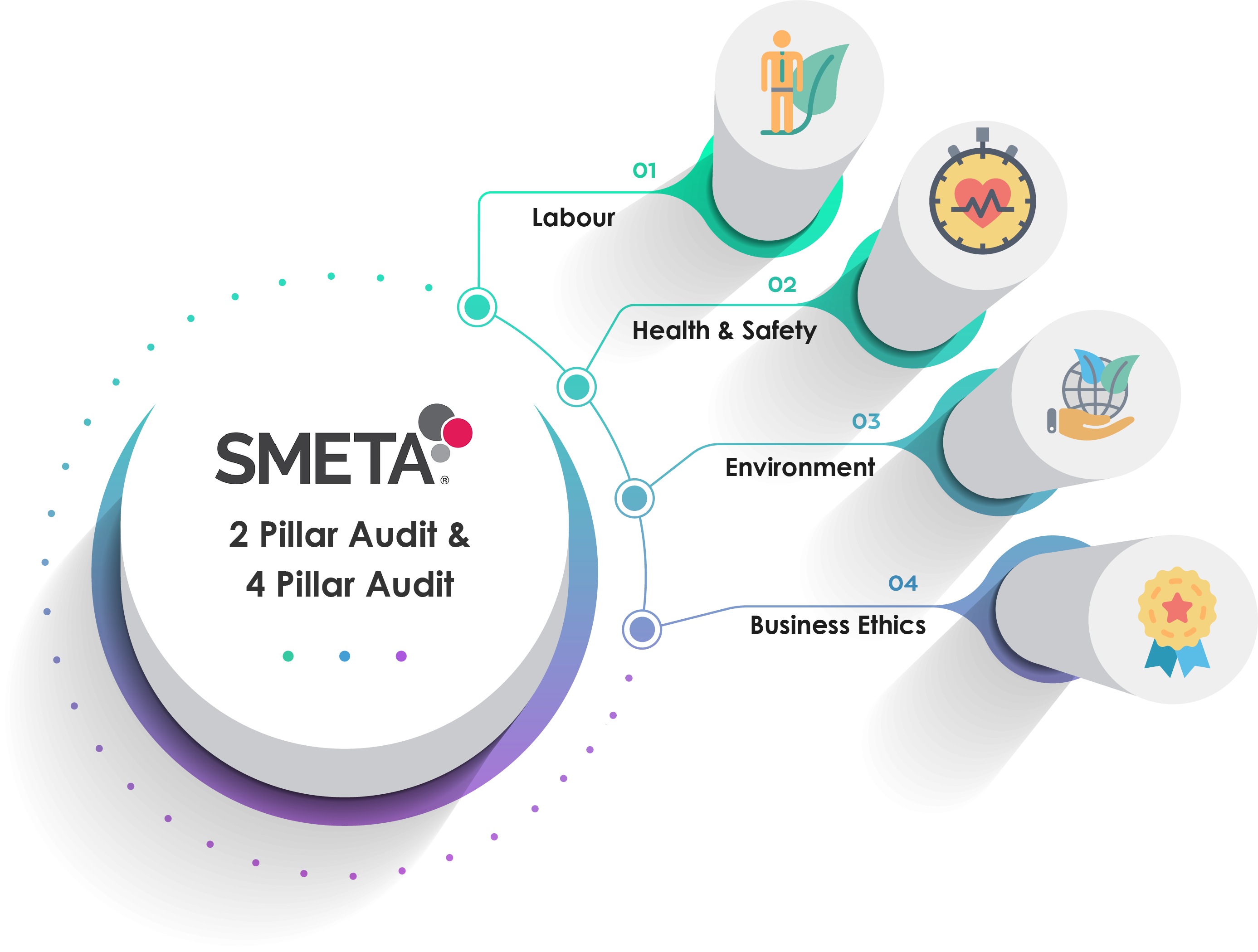
SMETA was developed as a social audit to measure the ease of assessing RBPs among Sedex supply chain partners. SMETA was developed to assess various labor, health & safety, business ethics, and environmental management standards for supply chain partners.
SMETA is not a certification.
It was created by Sedex and is used by worldwide brands to assess supplier compliance.
This audit helps buyers understand:
- Conditions of laborers
- Compliance with laws
- Safety of the workplace
- Ethical business practices
- Environmental performance
For exporters based in Egypt, SMETA is an essential component of supplier compliance assessment.
Why SMETA Is Now Critical for Egyptian Factories
Egypt's garment and textile sector is facing increased regulatory pressure to demonstrate supply chain compliance in markets. Understanding those pressures helps explain why SMETA requests are arriving in the inboxes of Egyptian factories at an increasing pace.
European Regulatory Wave
Three major laws now require European buyers to document and verify the ethical performance of their suppliers, making compliance proof a central buyer concern:
The EU Corporate Sustainability Reporting Directive (CSRD) requires large EU companies to disclose Scope 3 social risks, including supplier labor conditions in countries like Egypt.
Germany's Supply Chain Due Diligence Act (LkSG / Lieferkettensorgfaltspflichtengesetz) requires German companies to identify and remedy human rights risks in their global supply chains. A SMETA audit report is one of the primary accepted evidence documents.
The UK Modern Slavery Act requires UK companies above a revenue threshold to publish annual statements on how they address the risk of forced labor. Suppliers without a current SMETA report are a liability for UK buyers.
For Egyptian factories exporting to Germany, the UK, France, the Netherlands, or any EU market, these laws are not distant concerns—they directly determine whether your factory remains on the approved vendor list.
The QIZ–SMETA Connection
Egypt's Qualifying Industrial Zones (QIZs) allow duty-free access to the US market for products manufactured in designated zones across Greater Cairo, Alexandria, the Suez Canal Zone, Central Delta, Beni Suef, and Minya. In 2025, QIZ exports reached USD 1.4 billion, with 80% of those exports coming from apparel and textiles.
Many US retailers sourcing through QIZ channels now request SMETA alongside their existing C-TPAT or WRAP compliance requirements. A SMETA report signals to American buyers that your factory has been independently assessed against international labor and safety standards, not just price-competitiveness metrics.
Egypt's New Labor Law No. 14 of 2025
Egypt enacted a comprehensive new Labor Law, effective September 1, 2025, replacing Law No. 12 of 2003. Key changes relevant to SMETA compliance include:
- Minimum wage raised to EGP 7,000/month (March 2025)
- Overtime: 135% for daytime, 170% for nighttime work
- Maternity leave extended to 4 months.
- Anti-harassment provisions now require written internal disciplinary policies (Article 4)
- Establishments with 100+ female staff must provide nursery facilities.
- Employment contracts must be in Arabic and prepared in four copies.
SMETA audits assess compliance against local labor law, meaning SMETA in Egypt now evaluates factories against these new legal requirements. Factories that have not updated their HR documentation, payroll systems, and internal policies in line with the new law are at higher risk of SMETA non-conformances.
SMETA 2-Pillar vs 4-Pillar: Choosing the Right One For Your Factory
SMETA is offered in 2 versions. Choose the one your clients need.
SMETA 2-Pillar Audit
The 2-Pillar audit is the basic version and includes:
Pillar 1 — Labor Standards
- Compensation, working time, and overtime
- Child labor and minimum age
- Forced labor and association rights
- Non-discrimination and equal opportunity
- Right to work
- Subcontracting and home working
Pillar 2 — Health & Safety
- Fire safety
- Safety of machinery and PPE
- Safety of chemicals and hazardous materials
- Workplace hygiene and sanitation, and workplace canteens
- Medical and first aid services
- First aid and emergency procedures
The 2-Pillar audit contains a brief assessment of the environment and a review of management systems.
SMETA 4-Pillar Audit
The 4-Pillar audit adds 2 more sections:
Pillar 3: Environment Full assessment of the environment, including waste, pollution, water, energy, and chemicals, environmental permits, and assessment of environmentally safe practice. This pillar is fast becoming a requirement for European buyers under the CSRD and provides them with more comprehensive environmental coverage.
Pillar 4: Business Ethics: Anti-corruption, transparency in record-keeping, confidentiality, and fair competition.
| Feature | 2-Pillar | 4-Pillar |
| Labour Standards | ✓ | ✓ |
| Health & Safety | ✓ | ✓ |
| Shortened Environmental Assessment | ✓ | — |
| Full Environmental Assessment | — | ✓ |
| Business Ethics | — | ✓ |
| Most common for US buyers | ✓ | ✓ |
| Required for most EU buyers | Minimum | Preferred |
| Required under CSRD/LkSG evidence | Partial | Full |
Our recommendation for Egyptian factories: If your primary markets are European, especially Germany, the UK, France, or the Netherlands, request the 4-pillar audit. If you are primarily supplying US buyers through QIZ channels, the 2-pillar audit is generally sufficient to start, with many buyers later upgrading to 4-pillar as regulatory requirements grow.
The SMETA Audit Process: Step-by-Step
Here is a first-time SMETA audit example that completes some of the anxiety-inducing elements of the process. Below is a step-by-step outline for working with GSCS International in Egypt:
Step 1: Sedex Registration
Before a SMETA audit can begin, Sedex’s platform (sedex.com) requires your factory to be a member. Their membership allows the storage and sharing of your audit report across many buyers. This is the primary benefit of the SMETA system.
Step 2: Self-Assessment Questionnaire (SAQ)
After securing Sedex membership, Self-Assessment Questionnaires are completed for each Sedex Pillar. This is a detailed internal review. This step is particularly helpful for identifying gaps or issues that may be apparent to auditors. Audits tend to be less difficult for factories that self-complete the SAQ.
Step 3: Pre-Audit Gap Assessment (Recommended)
GSCS International recommends a gap assessment visit before the actual audit, especially if it is your factory's first time undergoing SMETA. For this informal pre-visit, a GSCS consultant will walk your factory floor, review documentation, and highlight issues/concerns that require attention. Factories that have a gap assessment completed save time, money, and stress for everyone on audit day.
Step 4: On-Site SMETA Audit
Formal audits are conducted by GSCS-trained auditors. The usual times taken per audit are:
- For small factories (under 150 employees), audits take 1 day.
- For medium factories (150–500 employees), audits take 1.5–2 days.
- For large factories (over 500 employees), audits take 2–3 days.
GSCS auditors will conduct an audit:
- Check all HR, payroll, and employment records.
- Examine the factory floor, equipment, safety, chemical storage, and facilities.
- Conduct private and confidential interviews with a sample of employees.
- Conduct separate interviews with the management and HR.
- Document photographs of the conditions and check permits and records.
As a requirement of SMETA, GSCS auditors will ensure management is not present when employees are interviewed.
Step 5: Audit Report and CAPR
Within a couple of days after the audit, GSCS provides:
- A SMETA Audit Report with all findings, details, and descriptions of conformities and non-conformities.
- A Corrective Action Plan Report (CAPR) that has all the findings with corrective action recommendations and deadlines.
The report is available on the Sedex platform, which provides direct access to it for your buyers. You determine the buyers who have access to your report.
Step 6: Corrective Actions and Follow-Up
The corrective actions in the CAPR are to be implemented by your factory. For minor findings, the evidence is posted on the Sedex platform. For major findings, a follow-up audit has to be conducted to verify that the finding has been closed.
GSCS International guides factories through the entire corrective action process, beyond the audit, which is an essential part of it.
SMETA Audit Cost in Egypt
Total SMETA audit costs depend on factory size, pillar scope, and the current state of your compliance systems.
| Factory Size | Audit Scope | Estimated Cost Range |
| Small (up to 150 workers) | 2-Pillar | USD 1,500 – USD 2,500 |
| Small (up to 150 workers) | 4-Pillar | USD 2,000 – USD 3,500 |
| Medium (150–500 workers) | 2-Pillar | USD 2,500 – USD 4,500 |
| Medium (150–500 workers) | 4-Pillar | USD 3,500 – USD 6,000 |
| Large (500+ workers) | 4-Pillar | USD 6,000 – USD 12,000+ |
How GSCS International Supports SMETA Audits in Egypt
GSCS International is a recognized certification, audit, and inspection company with a regional presence in Alexandria, Egypt, and is accredited by the Egyptian Accreditation Council (EGAC) under ISO/IEC 17020:2012.
GSCS provides end-to-end SMETA audit support for Egyptian factories, including:
Pre-audit gap assessment: An unofficial factory walk-through to identify documentation gaps, policy deficiencies, and physical safety issues before the formal audit. This is the single most effective step a factory can take to improve its first-time pass rate.
On-site SMETA audit: Conducted by trained auditors with in-depth knowledge of both SMETA 7.0 methodology and Egypt's specific legal requirements, including Labor Law No. 14 of 2025.
Audit report and CAPR delivery: Full SMETA-compliant report uploaded to the Sedex platform, with a practical corrective action plan that prioritizes findings by severity and ease of resolution.
Corrective action support: GSCS consultants guide your factory through implementing corrective actions, preparing evidence documentation, and meeting buyer-imposed deadlines for CAP closure.
Worker awareness training: Training sessions for factory floor workers and HR personnel on SMETA pillars, Egyptian labor rights, and what to expect during worker interviews.
Arabic-language support: All GSCS services in Egypt are delivered with full Arabic-language capability for factory management and worker communication.
GSCS serves factories across Egypt: in Greater Cairo, Alexandria, the Suez Canal Zone, the Central Delta, Beni Suef, and Minya covering the full geographic footprint of Egypt's QIZ-registered, export-oriented manufacturing sector.
Frequently Asked Questions
A SMETA (Sedex Members Ethical Trade Audit) is a third-party social compliance audit that assesses your factory's labour standards, health and safety practices, environmental performance, and business ethics. In Egypt, SMETA audits are conducted against both Sedex's international ETI Base Code standards and Egypt's local labour laws, including the new Labour Law No. 14 of 2025.
No. SMETA is an audit methodology, not a certification program. Completing a SMETA audit results in an audit report uploaded to the Sedex platform — not a certificate. Buyers access your report directly through Sedex, and one report can be shared with multiple buyers simultaneously.
SMETA audits must be conducted by Sedex-approved Affiliate Audit Companies (AACs). GSCS International is a recognised auditing body operating in Egypt with the expertise to conduct SMETA audits under the latest SMETA 7.0 methodology.
A 2-pillar audit covers Labour Standards and Health & Safety, the mandatory minimum. A 4-pillar audit adds a full Environmental Assessment and Business Ethics pillar. Most European buyers, particularly those subject to CSRD or the German LkSG, now require the 4-pillar version.
On-site audit duration ranges from one day for small factories (under 150 workers) to two to three days for larger facilities. The full process — from SAQ completion to receiving your audit report typically takes three to six weeks depending on factory readiness and audit scheduling.