How to Get WRAP Certification in Egypt for Textile Factories
Introduction
Egypt's garment and textile industry is one of the oldest and most powerful in Africa and the Middle East. With more than 2,500 apparel factories, over 1.5 million workers, and annual exports to the United States alone exceeding $1.4 billion through the QIZ program, Egyptian factories are no longer just competing on price. They are competing on trust, which is why certification matters.
As a result, international buyers, especially from the US and Europe, now ask a very simple question before placing orders: Are you WRAP certified?
If you manage or own a garment, textile, or footwear factory in Egypt and you are asking what WRAP certification is, how much it costs, and how to get it, this guide is written specifically for you. It will help you understand whether WRAP certification is the right next step for your factory.
What Is WRAP Certification?
WRAP stands for Worldwide Responsible Accredited Production. It is a non-profit organization established in 2000 and headquartered in Arlington, Virginia, USA. WRAP is the world's largest independent social compliance certification program focused exclusively on apparel, footwear, and sewn products.
Its mission is straightforward: to ensure that factories around the world treat workers fairly, operate safely, follow local laws, and meet internationally accepted ethical standards.
For Egyptian factories, WRAP certification is more than a document on the wall. It is a market access tool that helps secure orders. Over 700 buyers and retailers worldwide accept WRAP as proof of responsible sourcing — and many of them will not place orders without it. That makes WRAP especially relevant when you want to meet buyer expectations and secure orders.
Important 2026 Update: As of March 1, 2026, WRAP has retired the Gold, Silver, and Platinum certification levels. All factories that pass the WRAP audit now receive a single, annually valid Certificate of Compliance. Post-Certification Assessments (unannounced visits) continue throughout the certification period. If you have read older articles mentioning "Gold" or "Platinum" levels, please note this change.
Who Needs WRAP Certification in Egypt?
WRAP certification is ideal for:
- Garment factories
- Textile mills
- Footwear manufacturers
- Home textile factories
- Packaging factories
- Sewing factories
- Export-oriented production units
If you export apparel from Egypt, WRAP certification can increase your acceptance with buyers.
Common Challenges for Egyptian Factories
Many factories face:
- Incomplete worker records
- Excessive overtime
- Safety gaps
- Poor wage documentation
- Environmental compliance gaps
These issues can delay certification.
Preparing early is critical.
Future of WRAP Certification in Egypt
As Egypt grows as a sourcing hub, compliance certifications will become even more important.
International buyers are demanding:
- ethical sourcing
- transparent factories
- secure supply chains
Factories with WRAP certification will have stronger positioning.
The Importance of WRAP Certification for Egypt
Egypt is well-positioned in the global textile market. However, sustaining that competitive position requires compliance.
The QIZ Benefit and Compliance Demand
Along the Nile and in surrounding areas, Egyptian officials have established over twenty QIZs (Qualifying Industrial Zones). In these zones, factories can send goods to the US without a tariff, provided that 35% of the goods’ value was created in Egypt and some of the materials came from Israel.
QIZs accounted for $1.4 billion in US imports from Egypt in 2025 and make up half of total Egyptian imports. Apparel and textile items are the most produced (80%) goods in these zones.
Now here’s the important part. Competing in the US market at that level means that your factory must have more than just tariff-free goods. Your factory must have evidence of compliance. WRAP certification is the easiest and fastest option that your factory can provide to evidence compliance.
Egypt's New Labor Law: (Law No. 14 of 2025)
A new Labor Law was introduced in Egypt, and it went into effect on September 1, 2025. Law No. 14 of 2025 is a complete overhaul of Labor Law No. 12 of 2003. Major changes include:
- a minimum monthly wage of EGP 7,000 (as of March 2025)
- Maternity leave extended to 4 months
- overtime pay increased to 135% for daytime and 170% for nighttime
- increased protections against unlawful harassment and forced labor
- nurseries for businesses with 100 or more women employees
- new requirements for notice periods and contracts written in Arabic
WRAP's 12 Principles correspond to the changes in Egyptian law outlined above. Obtaining WRAP certification means your factory is audit-ready for Egyptian law and international buyers. This certification streamlines the audit process and approval for both laws and buyers.
Egypt's Export Scale Places Pressure on Buyers
Egypt's garment and textile sector comprises 3% of the country's GDP. It contributes 27% of the country's total industrial output. US exports total $1.3 billion, with $504 million to the EU. The pressure to comply with international standards and regulations is increasing for all buyers. American retailers who source from QIZ firms consider WRAP certification a prerequisite.
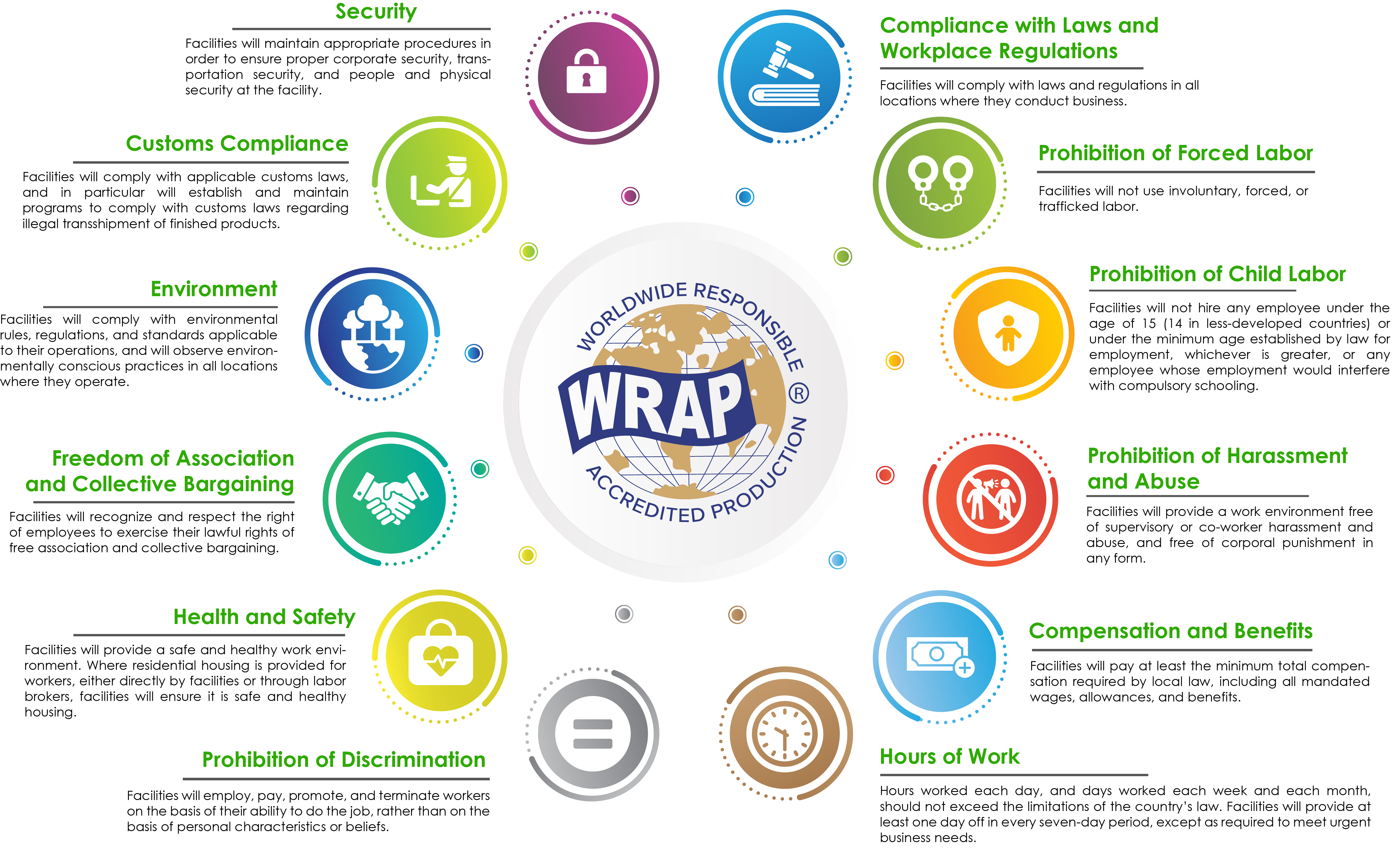
The 12 Principles of WRAP Certification
WRAP certification evaluates every factory against 12 core principles. Below is what each one means for Egyptian factories:
| Principle | What It Means for Egyptian Factories |
| No Child Labor | Workers must meet Egypt's minimum legal working age |
| No Forced Labor | All employment must be fully voluntary — no deposits, no document confiscation |
| No Harassment or Abuse | Workers must be treated with dignity; aligned with Law No. 14 of 2025, Article 4 |
| Compensation & Benefits | Wages must meet or exceed EGP 7,000/month minimum; overtime paid correctly |
| Hours of Work | Maximum 48 hours/week standard; overtime laws must be followed |
| Non-Discrimination | Equal opportunity regardless of gender, religion, or nationality |
| Health & Safety | Safe working conditions maintained per Egyptian occupational safety standards |
| Freedom of Association | Workers may join trade unions freely under Egyptian law |
| Environment | Compliance with Egypt's environmental protection regulations |
| Customs Compliance | Accurate import/export documentation; critical for QIZ factories |
| Security | Protection against unauthorized access and supply chain security risks |
| Management Systems | Internal policies, monitoring, and documentation properly maintained |
Advantages of WRAP Certification for Egypt-Based Production Facilities
1. Trading with America
The USA is Egypt's largest market, with most large US retailers and brands requiring WRAP certification, even for sourcing through QIZ programs. Your factory could be completely excluded from a tender listing without this certification.
2. Fewer Redundant Audits
One of the biggest challenges garment factories in Egypt face is the frequent audits by buyers throughout the year. These can be both costly and disruptive to day-to-day operations. WRAP certification is accepted by over 700 brands, eliminating the need for most brand-specific audits.
3. C-TPAT Compliance
To compare WRAP certification with the US Customs-Trade Partnership Against Terrorism (C-TPAT) program for QIZ factories currently exporting to the US, WRAP certification can be used to satisfy a program’s security audit and screening requirements, thereby relieving multiple security audits.
4. Better Retention of Employees
Garment factories in Egypt that have adopted some or all of the WRAP principles have reported improved employee retention. This is attributed to higher wages, better working conditions, and greater job satisfaction in challenging job environments.
5. Trust in the System
GSCS International is an accredited inspection body by the Egyptian Accreditation Council (EGAC) for ISO/IEC 17020:2012. Therefore, WRAP audits conducted by GSCS in Egypt have the added credibility of an EGAC-accredited inspection body, thereby giving your certificate greater leverage with both local authorities in Egypt and international clients.
A Step-by-Step Guide to WRAP Certification for Egyptian Factories
Getting WRAP-certified as an Egyptian factory involves following its own procedures and meeting its expectations. Here's what you can expect:
Step 1: Registration and Application
Your factory creates an account on the WRAP compliance portal and submits the application, along with the registration fee. The WRAP registration fees for 2024 are as follows, based on factory size:
| Factory Size (Workers) | Registration Fee |
| Up to 100 workers | USD 650 |
| 101–200 workers | USD 950 |
| 201–1,000 workers | USD 1,350 |
| 1,001+ workers | USD 1,550 |
Step 2: Self-Assessment
Your factory assesses itself against the 12 WRAP principles through a detailed self-assessment questionnaire. This internal review is not a formality; it actually helps you mitigate the risks of non-conformance before the assessor arrives. Factories that take this seriously almost always achieve smoother audit outcomes.
Step 3: Choose an Accredited Audit Body
A third-party WRAP-approved auditing company must conduct the audit. GSCS International is a WRAP-recognized auditing body operating in Egypt and with a regional office in Alexandria. GSCS auditors are trained on WRAP international standards and the labor and environmental laws of Egypt, including the new Labor Law No. 14 of 2025.
Step 4: Gap Assessment (Recommended Pre-Step)
GSCS would suggest a gap assessment visit before the formal audit. This is an unofficial pre-review assessment in which GSCS auditors walk through your facility, assess potential non-conformances, and formulate corrective actions for your team. Factories that conduct gap assessments before formal audits tend to have a much higher first-time pass rate.
Step 5: On-Site WRAP Audit
The formal audit takes one to two days, depending on the size and complexity of the factory. GSCS auditors will:
- Examine all factory documentation, including policies and records of employees who are in human resources
- Inspect the facility one floor at a time
- Conduct one-on-one interviews with employees and supervisors
- Determine applicable WRAP compliance to all twelve principles
Interviews are conducted one-on-one to provide assurance of employee honesty. This is a standard WRAP procedure in all countries.
Step 6: Corrective Action Plan (CAP)
After the audit, your factory will receive a report with a breakdown of findings. Your factory will need to create a CAP to address all non-conformances identified, which is to be expected in a first-time audit. GSCS will assist you in developing a CAP.
Step 7: Certification Issuance
After WRAP reviews the audit and GSCS approves your CAP (if applicable), your factory will receive a Certificate of Compliance. Your factory will be listed on the WRAP registry, which is visible to buyers worldwide.
How GSCS International Supports WRAP Certification in Egypt
GSCS International's regional office in Alexandria, Egypt, conducts WRAP audits. As an EGAC-accredited inspection body and WRAP-approved audit firm, GSCS offers a full range of services, such as:
- Pre-audit gap assessments
- Independent WRAP audit by certified and experienced auditors
- Guidance for developing a Corrective Action Plan (CAP)
- Training factory employees on compliance with WRAP, Egyptian labor laws, and ethical standards
- Support for renewal and recertification to ensure compliance
- Support in Arabic for the management and staff of Egyptian factories
GSCS auditors possess extensive knowledge of the WRAP international requirements and Egypt's laws, including the new Labor Law No. 14 of 2025, the laws of the Egyptian Environmental Protection, and QIZ Customs Compliance laws.
Frequently Asked Questions
WRAP (Worldwide Responsible Accredited Production) certification is an internationally recognized social compliance standard that verifies Egyptian garment and textile factories operate ethically, safely, and in accordance with local labor laws and international standards.
WRAP is not legally mandated by the Egyptian government. However, many international buyers — particularly US retailers sourcing through QIZ factories — require WRAP certification as a condition of doing business. In practice, it has become a commercial requirement for export-oriented factories.
Total costs typically range from USD 2,000 for small factories to USD 15,000 or more for large operations, depending on factory size, audit complexity, and compliance readiness. This includes WRAP registration fees and audit costs.
Most factories complete the process in 4 to 8 weeks from the time of application, assuming no major non-conformances. Factories with significant compliance gaps may require additional time for corrective actions.
As of March 1, 2026, WRAP retired the tiered certification system. All factories that pass the WRAP audit now receive a single Certificate of Compliance, valid for one year. Post-Certification Assessments (unannounced) continue throughout the certification period.