
C-TPAT Audit in Egypt: Benefits, Process & Supply Chain Security
Introduction
As global trade evolves, international buyers increasingly emphasize supply chain security, product quality, and competitive pricing. Companies exporting to the United States must show that their supply chains are secure, transparent, and protected against risks such as cargo theft, smuggling, terrorism, and unauthorized access.
For Egyptian exporters, particularly those in the garment, textile, footwear, packaging, and manufacturing industries, meeting these expectations can create a competitive advantage. Many U.S. importers prefer suppliers that follow internationally recognized supply chain security practices and are prepared for C-TPAT audits, thereby strengthening supplier selection and long-term business relationships.
C-TPAT (Customs Trade Partnership Against Terrorism) is crucial to our engagement.
Although C-TPAT is a Program of the U.S. Customs and Border Protection (CBP) linked to importers, several overseas manufacturers and suppliers, including businesses in Egypt, must also observe C-TPAT security requirements to sustain business with U.S. contracting partners.
For businesses seeking C-TPAT Audit in Egypt, compliance with these security measures demonstrates a commitment to safe global trade and provides greater buyer assurances and supply chain enhancements that inform audit readiness and market expansion.
If you are a garment factory, textile mill, logistics provider, warehouse, packaging company, exporter, etc. Understanding C-TPAT can help you reduce supply chain risk and access the U.S market.
In this all-inclusive guide, you will discover all you need to know about C-TPAT Audit in Egypt, the requirements, benefits, and security of your organization, and how you can prepare for a successful audit with the knowledge to make informed compliance decisions.
What is C-TPAT?
Customs-Trade Partnership Against Terrorism (C-TPAT) is a voluntary supply chain security initiative controlled by the U.S. Customs and Border Protection (CBP) after the attacks on September 11.
The process is a partnership. The U.S. government and the private sector join together. The goal is to secure international supply chains. C-TPAT members agree to place additional security measures on their businesses and supply chains. In return, U.S. CBP provides considerable trade rewards. Those rewards include fewer customs inspections, faster processing of cargo at U.S. ports, and preferential treatment.
C-TPAT members clear 50% of the total value of U.S. imports. The value of this program to exporters from Egypt is clear.
Important distinction for Egyptian factories. C-TPAT membership is not open to Egyptian factories and manufacturers. C-TPAT is a membership program for U.S.-based importers, brokers, and select foreign entities. However, CBP requires U.S. importers who are C-TPAT members to ensure that their foreign suppliers, including Egyptian factories, comply with C-TPAT security requirements. This is the foundation for the C-TPAT audit of Egyptian factories.
Why C-TPAT Compliance Is Now Essential for Egyptian Exporters
The QIZ–C-TPAT Connection
In Egypt, the most valuable program for the garment and textile industry is the Qualifying Industrial Zones (QIZ); as of September 2025, 1,293 companies operate in 20 or more QIZs across Greater Cairo, Alexandria, the Suez Canal Zone, the Central Delta, Beni Suef, and Minya. In 2025, exports from QIZs were $1.4 billion, with 80% of total exports being clothing and accessories.
All products sent from QIZ factories to US retailers are subject to US Customs. The US importer is a C-TPAT member. That importer must ensure that their Egyptian supplier complies with the C-TPAT minimum security standards, as required by CBP.
For QIZ factory managers who work with WRAP, SMETA, and other social compliance frameworks, the introduction of C-TPAT emphasizes supply chain transparency and security, as well as cargo integrity, rather than labor standards.
US Trade Policy and Supply Chain Compliance
The years 2024 through 2026 will bring the most stringent requirements to the US supply chain security in history. US Executive Order 14028, the Safe Port Act, and CBP’s ongoing improvements to the C-TPAT Minimum Security Criteria (MSC) have all increased the compliance burden on foreign manufacturers that supply US Importers.
Also, C-TPAT now has Mutual Recognition Arrangements (MRAs) with nineteen foreign customs organizations. The latest MRA was signed with the South African Revenue Service in June 2025. Even though there is no MRA between Egypt and C-TPAT, Egyptian factories that export through QIZ are fully subject to the foreign manufacturer security requirements set by the U.S. Customs and Border Protection (CBP).
This Shift is Competitive
The shift is evident and practical. U.S. retailers and brands that were C-TPAT members and relied on WRAP or SMETA reporting to meet security compliance requirements are now sending their Egyptian business partners the C-TPAT Foreign Manufacturer Security Questionnaire (FMSQ). Factories that cannot complete the questionnaire or demonstrate compliance through a third-party audit risk losing business, regardless of how strong their social compliance is.
While WRAP certification partially meets the C-TPAT security requirements, especially those for access control and personnel security, it does not meet the requirement for a C-TPAT security audit. Where buyers require C-TPAT compliance, an additional security audit is required.
Key Security Requirements of C-TPAT
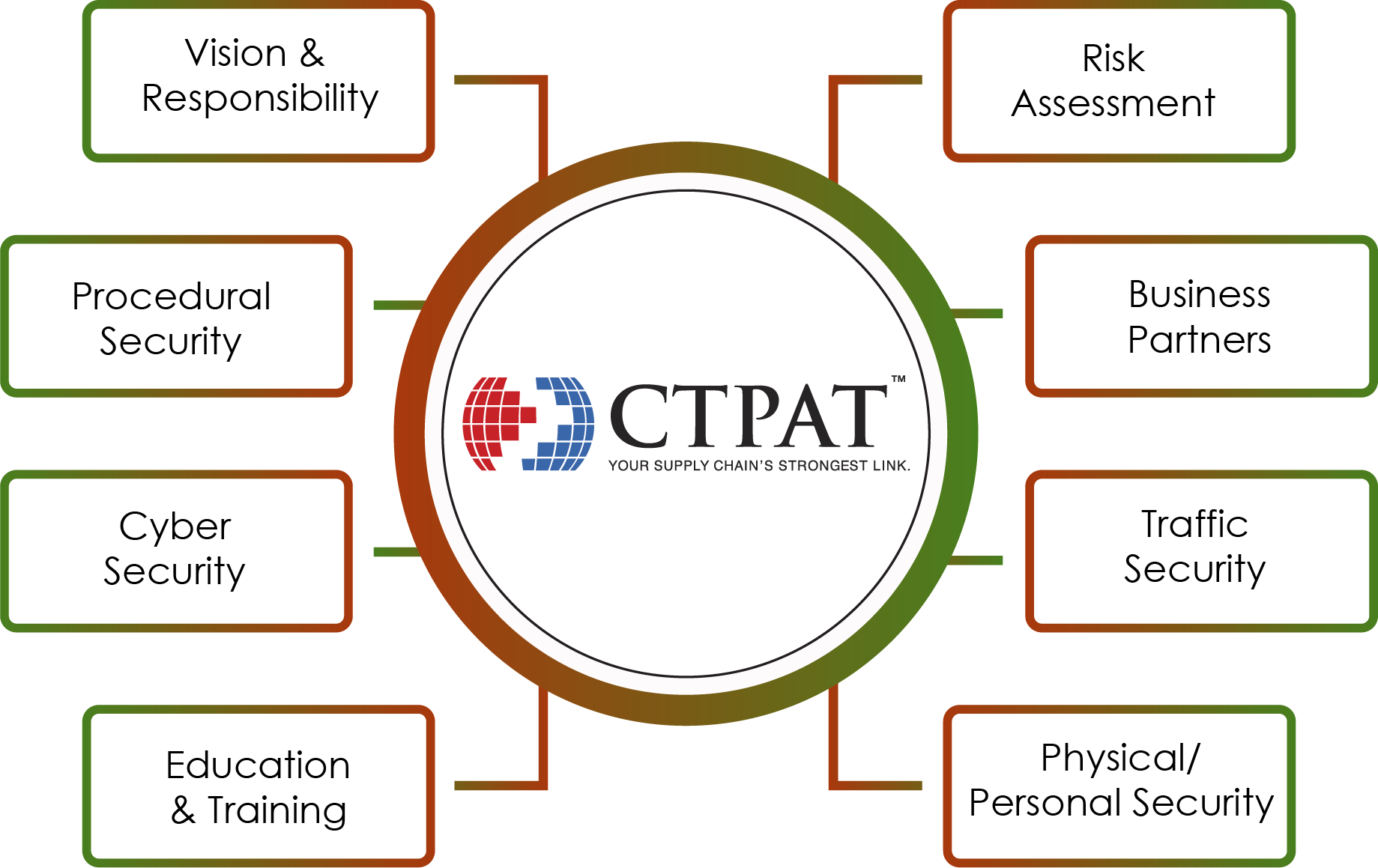
C-TPAT takes a comprehensive approach to supply chain security. It evaluates security across multiple operational processes rather than focusing on a single area.
The key security areas organizations should address when preparing for a C-TPAT Audit in Egypt are listed below.
1. Physical Security
Facilities must have appropriate physical safeguards to prevent unauthorized access during audit review.
This includes:
- Secure perimeter fencing
- Controlled entry and exit points
- Visitor management
- Security guards
- Adequate lighting
- Alarm systems
- CCTV surveillance
- Locked storage areas
Strong physical security reduces opportunities for theft and unauthorized activities. In the same way, it supports better overall supply chain protection.
2. Personnel Security
Employees play an important role in supply chain security and audit readiness.
Organizations should establish procedures for:
- Employee background verification
- Identity management
- Access control
- Security awareness
- Staff training
- Reporting suspicious activities
Proper personnel management helps reduce insider risks and supports the next layer of cargo security.
3. Cargo Security
Cargo protection is one of the most critical aspects of C-TPAT audit readiness.
Companies should implement procedures for:
- Cargo inspections
- Seal verification
- Container integrity checks
- Loading supervision
- Shipment documentation
- Tamper prevention
These controls help ensure shipments remain secure throughout transportation and underscore the need for robust information security.
4. Information Technology Security
Modern supply chains rely heavily on digital systems that auditors will review.
Organizations should protect sensitive business information through:
- Password management
- User access controls
- Data backup
- Cybersecurity awareness
- Antivirus protection
- Secure networks
IT security is becoming increasingly important as cyber threats continue to grow, and this concern extends to business partner security as well.
5. Business Partner Security
Supply chain security extends beyond one company and should be reviewed across business partners.
Businesses should evaluate suppliers, logistics providers, transport companies, and subcontractors to ensure they also follow appropriate security practices.
This creates a stronger, more reliable supply chain, making security training and awareness essential.
6. Security Training and Awareness
Employees should understand:
- Security responsibilities
- Emergency procedures
- Reporting suspicious activities
- Cargo protection
- Visitor control
- Security incident response
Regular training helps create a strong security culture throughout the organization and reinforces all other security measures.
Who Needs C-TPAT Audit in Egypt?
Many organizations throughout the supply chain benefit from C-TPAT security requirements.
Businesses that commonly require C-TPAT Audit in Egypt include:
- Garment factories
- Textile manufacturers
- Apparel exporters
- Home textile producers
- Footwear manufacturers
- Packaging companies
- Logistics providers
- Freight forwarders
- Warehousing companies
- Distribution centers
- Manufacturing facilities
- Export-oriented businesses
If your company exports products to the United States or supplies international brands, a C-TPAT audit can help confirm your security practices and improve your competitiveness.
The C-TPAT Compliance Process: Step-by-Step for Egyptian Factories
Step 1: Receiving and Completing the Foreign Manufacturer Security Questionnaire (FMSQ)
Your process will begin when your U.S. customer, as a C-TPAT member, sends your factory the Foreign Manufacturer Security Questionnaire (FMSQ). This covers the nine C-TPAT security domains and requires your factory to report and describe security practices, policies, and infrastructure.
Everything that follows will depend on your response to the questionnaire. An FMSQ that is completed incorrectly or incompletely will cause issues and will not be accepted by your customer. GSCS International will assist Egyptian factories in preparing and completing the FMSQ correctly prior to submission.
Step 2: Prep Gap Assessment
GSCS International will conduct a gap assessment as a pre-audit at your factory and evaluate security practices before the formal C-TPAT onsite security audit. This will take the form of an audit walk and will assess physical security, security documentation, container security, and IT security practices.
This assessment will be mandatory for factories that are beginning the C-TPAT compliance process. The gap assessment will help identify key areas for improvement prior to the formal audit.
The most common findings in Egyptian factories that undergo this pre-assessment are: inadequate exterior security, insufficient CCTV coverage, missing employee background checks, missing seal logs, and a lack of formal security training documentation.
Step 3: Corrective Action Implementation
Based on the gap assessment findings, your factory implements the necessary corrective actions. GSCS International provides detailed, prioritized corrective action guidance, not just a list of deficiencies, but practical steps for addressing each finding in the context of your specific facility type, size, and location.
Some corrective actions are procedural and can be completed quickly, such as updating seal log templates, creating security training materials, and formalizing visitor access logs. Others, such as CCTV upgrades or perimeter improvements, require physical investment and longer lead times. Understanding the timeline helps factories realistically plan their compliance journey.
Step 4: C-TPAT Security Audit conducted on the premises.
The formal security audit is conducted by a GSCS-certified security auditor in this area. The on-site audit lasts one to two days, depending on the size and complexity of the factory being audited. The GSCS security auditor:
- Writes a complete assessment of the security audit that includes a review of loading docks, cargo storage, access and exit points, and perimeter security
- Reviews all security documents, logs, and access control records and systems, employee ID security, and background IT security
- Interviews management and security personnel to ascertain the security operations procedures being performed
- Reviews the container inspection process and compliance of the seals to ISO 17712
- Reviews security vetting and assessment of all business partners in the supply chains to the United States
Step 5: Audit Report and Corrective Action Plan
Your factory receives a comprehensive audit report and a Corrective Action Plan (CAP) that identifies any remaining non-conformities, along with prioritized remediation steps and timelines.
This report is delivered directly to your US buyer as evidence of your factory's C-TPAT security compliance status. Buyers typically require CAP closure within a defined timeline, usually 60 to 90 days for minor findings, with immediate action required for critical findings.
Step 6: Annual Re-Assessment
CBP requires C-TPAT member importers to ensure their foreign suppliers conduct a comprehensive security assessment at least annually. Egyptian factories that have completed their first C-TPAT compliance audit should plan for annual reassessments as a standard part of their compliance calendar alongside WRAP renewal, SMETA annual re-audit, and any other buyer-specific requirements.
Estimated C-TPAT Audit Cost in Egypt
Total costs depend on factory size, current security infrastructure, the number of facilities involved, and corrective action requirements.
| Factory Size | Estimated Total Cost | Notes |
| Small (up to 150 workers) | USD 2,000 – USD 4,000 | Basic audit, documentation review |
| Medium (150–500 workers) | USD 4,000 – USD 8,000 | Detailed security audit with CAP support |
| Large (500–1,500 workers) | USD 8,000 – USD 15,000 | Multi-day audit, complex operations |
| Very large (1,500+ workers) | USD 15,000+ | Multiple buildings, complex supply chain |
These estimates cover the gap assessment, on-site security audit, and CAP report. Physical security upgrades CCTV installations, seal procurement, perimeter improvements are factory costs that fall outside audit fees and should be budgeted separately based on gap assessment findings.
How GSCS International Supports C-TPAT Compliance in Egypt
GSCS International is a recognized security audit and compliance firm with a regional office in Alexandria, Egypt, and accreditation from the Egyptian Accreditation Council (EGAC) under ISO/IEC 17020:2012. GSCS provides complete C-TPAT compliance support for Egyptian factories, including:
Foreign Manufacturer Security Questionnaire (FMSQ) support: Guided completion of the CBP questionnaire to ensure accurate, complete responses that reflect actual factory conditions and set realistic expectations with your US buyer.
Pre-audit gap assessment: A factory walkthrough that identifies security deficiencies before the formal audit, allowing your team to implement corrective actions without audit pressure.
On-site C-TPAT security audit: Conducted by experienced security auditors with in-depth knowledge of CBP's Minimum Security Criteria, QIZ customs requirements, and Egyptian factory operational realities.
Corrective Action Plan (CAP) guidance : Practical, prioritized corrective action support that distinguishes between quick procedural fixes and longer-term physical infrastructure improvements.
Security training development : Creation of factory-specific security awareness training materials in Arabic, covering tamper identification, reporting procedures, and container security protocols.
Frequently Asked Questions
A C-TPAT audit in Egypt is a third-party security assessment that evaluates whether an Egyptian factory's physical security, cargo handling, personnel procedures, and documentation meet US Customs and Border Protection's Minimum Security Criteria (MSC) for foreign manufacturers. It is conducted to satisfy the compliance requirements of US importers who are C-TPAT members.
No. C-TPAT membership and certification is available only to US-based entities and specific categories of foreign participants. Egyptian factories cannot apply for C-TPAT membership directly. Instead, they demonstrate compliance with C-TPAT Minimum Security Criteria through a third-party security audit, which satisfies the vetting requirement imposed on their US importer buyers.
S importers who are C-TPAT members are required by CBP to ensure all their foreign suppliers, including Egyptian QIZ factories, meet C-TPAT security standards. With 1,293 companies in Egypt's QIZ program exporting USD 1.4 billion annually to the US, C-TPAT compliance is a direct commercial requirement for maintaining US buyer relationships.
No. WRAP and C-TPAT address fundamentally different compliance areas. WRAP focuses on labour standards and social compliance; C-TPAT focuses on physical security, cargo integrity, container security, and supply chain vetting. US buyers that specifically request C-TPAT compliance will not accept WRAP certification as a substitute.
The on-site security audit typically takes one to two days depending on factory size and complexity. The full process from FMSQ completion through gap assessment, corrective action implementation, and formal audit typically takes six to twelve weeks for factories undergoing C-TPAT compliance for the first time.