WRAP Certification in Cambodia for Garment & Textile Factories
Introduction
Cambodia's garment industry is one of the most dynamic in Southeast Asia. With over 918,000 workers employed directly in the sector and exports projected to surpass $13 billion, Cambodian factories are under growing pressure to prove they operate responsibly. International buyers, especially from the United States and Europe, no longer just ask about price and delivery time. They want compliance. They want documentation. They want WRAP certification.
If you manage or own a garment, footwear, or textile factory in Cambodia and you're asking, "What is WRAP certification, and do I need it?" this guide is written for you.
What Is WRAP Certification and Why Does It Matter for Cambodia?
WRAP means Worldwide Responsible Accredited Production. They focus on factories that produce apparel, footwear and other sewn products. They are the largest independent social compliance certifications. They began in 2000 and are based in Arlington, VA. Their goal is to create a world where factories treat workers fairly, operate safely, and follow the legal guidelines.
For Cambodia’s factories, WRAP certification, which stands for Worldwide Responsible Accredited Production, means something more to them. It means that many American buyers are looking for it. More than 700 buyers and retailers accept WRAP as a standard for responsible sourcing. If apparel factories want to do work with US retailers, WRAP certification is mandatory.
Exclusive trade access is not enough for Cambodia’s garment factories to attract new buyers, as they also need to meet additional requirements such as competitive pricing and compliance with international labour standards. These factories also need duty-free access to the European Union. This is the Everything But Arms agreement. There is also preferential treatment for US tariffs. Today’s buyers expect more. A WRAP Gold or Platinum certification shows factories are most compliant.
Why WRAP Certification is Important in Cambodia
Cambodia is one of the fastest-growing apparel manufacturing centers in Asia. As a result, a number of international fashion brands have started sourcing finished garment products from factories in Cambodia. However, these brands mandate that factories practice compliance at all levels, from operational to managerial.
This creates a competitive advantage for Cambodian factories that can obtain WRAP certification.
Some of the possibly inherent benefits of being WRAP certified include the following:
- Meet buyer compliance requirements
- Build trust with international brands
- Reduce the need for multiple audits
- Improve factory reputation
- Increase export opportunities
In most cases, employers at Cambodian factories have shifted from seeking a WRAP competitive advantage to meeting WRAP certification compliance requirements.
The 12 Principles of WRAP Certification
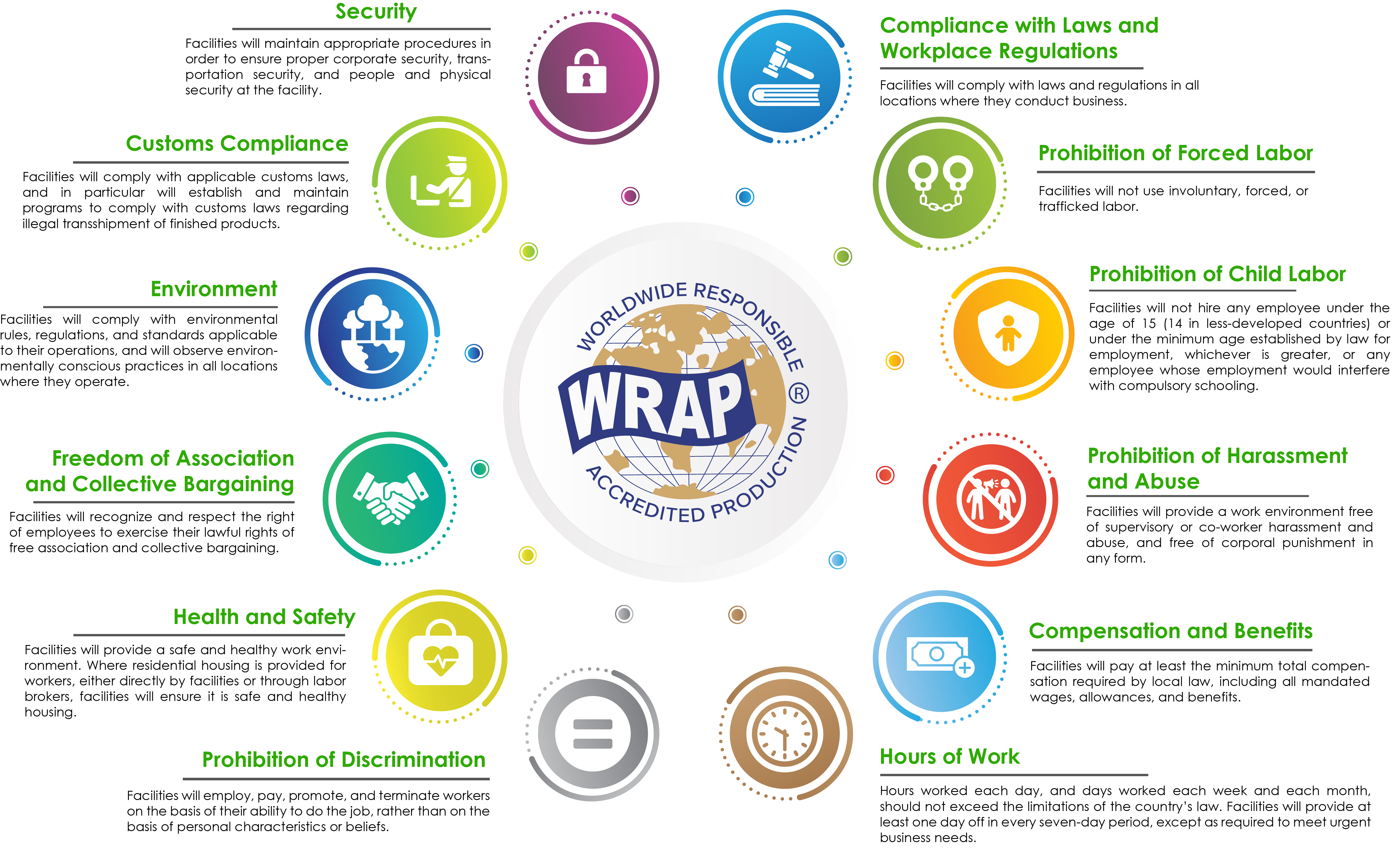
WRAP certification is built around 12 core principles that ensure ethical and responsible production.
WRAP Compliance Principles Overview
| Principle | Description |
| No Child Labor | Workers must meet legal age requirements |
| No Forced Labor | Employment must be voluntary |
| No Harassment or Abuse | Workers must be treated with dignity |
| Compensation & Benefits | Fair wages and legal benefits must be provided |
| Hours of Work | Working hours must comply with laws |
| Non-Discrimination | Equal opportunity for all workers |
| Health & Safety | Safe working conditions must be maintained |
| Freedom of Association | Workers can join associations freely |
| Environment | Compliance with environmental regulations |
| Customs Compliance | Legal import/export practices |
| Security | Protection against unauthorized activities |
| Management Systems | Proper policies and monitoring systems |
Advantages of WRAP Certification for Factories Based in Cambodia
WRAP opens doors.
Engagement with American Manufacturers
Cambodian buyers want the American market. Most American retail firms want WRAP certification. A gold certification is even more valuable.
Less Buyer Audit Fatigue
WRAP subjects your factory to numerous brand audits. Your company will have fewer audits, as WRAP is accepted by over 700 brands.
C-TPAT Compliance
Since WRAP and the Customs-Trade Partnership Against Terrorism (C-TPAT) have similar guidelines, generally speaking, WRAP-certified factories meet the standards for security set by C-TPAT and leave U.S. customs audits exempt.
Decreased turnover, along with better sewing efficiency
More sewing factories that have safe environments with less tactile exposure, better pay, and better rights generally have less turnover. In the competitive sewing market, retained workers are more cost-effective.
Better Brand Recognition
More sewing facilities that are WRAP certified are accepted by the WRAP registry, buyers, NGOs, and the media, which, more than anything, shows that your factory is operating in the full light of the market.
The WRAP Certification Process: Step-by-Step for Cambodia Factories
The WRAP certification process is predictable with the following steps:
Step 1: Registration and Application
The factory signs up for a WRAP compliance portal account and submits the registration fee and application. WRAP registration fees for 2024 begin at $650 for 100-worker factories and $1,550 for 1000-worker factories.
Step 2: Self-Assessment
Factories in the compliance process fill out a self-assessment questionnaire that covers the 12 WRAP principles. Self-assessments are geared as internal factory reviews and to help identify deficiencies before the audit, ensuring that factories can address any issues related to the 12 WRAP principles proactively.
Step 3: Choosing an Accredited Auditing Body
The WRAP preference is to choose an independent third-party WRAP-approved auditing company. One such company is GSCS International, a recognised international auditing and certifying company that has conducted WRAP audits for factories in the Asia region, Cambodia, and all neighbouring countries.
Step 4: On-Site Audit
The onsite audit lasts between one and two days depending on the size of the factory. During the audit, the GSCS International auditing company conducts a review of all factory documents and a firm-wide inspection to review the 12 principles of WRAP. Auditors will also conduct interviews with employees and contractors in a private setting to help determine the correspondence of factory or firm policies to the actual practices of the factory or firm. Interviews with employees and contractors are interindustry quality practices and an independent review process.
Step 5: Corrective Action Plan (CAP)
Every factory receives a report with all findings after an audit, and a CAP (Corrective Action Plan) is expected from the factory. It's typical for a first audit to locate issues, and very few factories pass an initial audit without any findings. The CAP process is a demonstration to WRAP from the factory of a willingness to improve.
Step 6: Certification Issuance
Platinum, gold, or silver, the certificate is issued after WRAP reviews the audit and accepts the CAP. Your factory is then publicly listed on the WRAP website.
WRAP Certification Cost in Cambodia
The cost of WRAP certification in Cambodia can vary depending on several factors, including factory size, number of employees, production complexity, and current compliance level.
While there is no fixed universal price, most factories can expect costs to fall within a reasonable range based on their operational scale.
Estimated WRAP Certification Cost
| Factory Size | Estimated Cost Range | Details |
| Small Factory (50–150 workers) | $2,000 – $4,000 | Basic audit and certification process |
| Medium Factory (150–500 workers) | $4,000 – $8,000 | More detailed audit and documentation review |
| Large Factory (500+ workers) | $8,000 – $15,000+ | Complex operations and multi-day audits |
How GSCS International Supports WRAP Certification in Cambodia
GSCS International has built a reputation for itself for performing social compliance audits throughout Southeast Asia and is able to expand its work to the rest of the world. They are a WRAP-approved auditing firm and are a key support for Cambodian garment factories in the following ways:
- Conduct a gap assessment in the factory before the formal WRAP audit to uncover issues.
- Perform WRAP third-party audits with WRAP-certified auditors.
- Guide the factory in the corrective action plans to address the issues discovered.
- Conduct GSCS International training for factory staff on how to comply with WRAP and on best practices.
- Maintain the Gold or Platinum certification levels through recertification.
GSCS International auditors have a command of WRAP standards as well as the Cambodian laws. The Cambodia Labour Law, the Ministry of Social Affairs, and environmental laws are a few of the areas that fall under audit defensibility.
GSCS International is the ideal choice for your factory, whether it's your first time pursuing WRAP or renewing a certification, as we offer the necessary support and expertise.
Conclusion
As global buyers continue to prioritise ethical sourcing and responsible production, certifications like WRAP are becoming essential in the textile and garment industry.
For factories in Cambodia, obtaining WRAP certification is not just about compliance—it’s about building trust, improving operations, and unlocking new business opportunities.
By demonstrating compliance with international labour and safety standards, WRAP-certified factories gain a strong competitive advantage in the global market.
With the support of GSCS International, companies in Cambodia can successfully achieve WRAP certification and position themselves as reliable, ethical, and globally trusted manufacturing partners.
Frequently Asked Questions
WRAP certification is an international standard that ensures factories in Cambodia follow ethical labor practices, safety regulations, and legal compliance in manufacturing.
To obtain WRAP certification, factories must apply through an approved body, complete a self-assessment, pass an audit, and implement corrective actions if required.
The cost typically ranges from $2,000 to $15,000+, depending on factory size, audit complexity, and compliance readiness.
WRAP certification helps factories meet international buyer requirements, improve working conditions, and increase export opportunities.
The process usually takes 4 to 8 weeks, depending on audit results and how quickly corrective actions are completed.
Garment factories, textile manufacturers, footwear producers, and export-oriented factories often require WRAP certification to work with global brands.