SMETA Audit Services in Cambodia for Ethical Manufacturing Compliance
Introduction
Cambodia's garment and manufacturing industry has grown remarkably over the past decade. With over 1,682 garment factories operating as of mid-2025 and exports reaching $7.38 billion in the first half of the year alone, Cambodian factories are supplying some of the world's biggest brands. But with that growth comes a serious responsibility; international buyers don't just want quality products anymore. International buyers now demand evidence of ethical, safe, and responsible production.
That's exactly where SMETA (Sedex Members Ethical Trade Audit) comes in.
If you run a factory in Cambodia, whether in Phnom Penh, Siem Reap, Sihanoukville, or anywhere else in the Kingdom, and your buyers are asking for a SMETA audit, this guide will walk you through everything you need to know. This guide covers SMETA, how to prepare for it, and why GSCS International is the best partner for your audit.
What Is SMETA and Why Does It Matter for Cambodian Factories?
The Sedex Members Ethical Trade Audit is known as SMETA. SMETA is the most used social audit. A social audit is used to assess the ethical practices in a company’s supply chain. SMETA is managed by Sedex, and Sedex is a non-profit company.
SMETA audits determine whether factories are:
- Legally compensating their employees
- Providing employees a safe and healthy environment
- Protecting the environment
- Conducting the business ethically and honestly
For factories in Cambodia that want to export their products to the EU, UK, US, Japan, or Canada, SMETA certification (Sedex Members Ethical Trade Audit) is mandatory. Brands like Walmart, H&M, ASOS, and Primark are some global brands that need their suppliers in Cambodia to carry a valid SMETA audit report.
If global brands supply products from factories in Cambodia that mistreat employees, for example, by employing them using child labour. The brands will receive negative consequences. Some may stop purchasing. To protect their business, SMETA audits allow global brands to trust that their suppliers in Cambodia are actually treating their employees ethically.
What Exactly is a SMETA Audit?
SMETA stands for “Sedex Members Ethical Trade Audit". SMETA is a methodology used for ethical audits across the world to measure a company’s responsible behaviour throughout its supply chain.
Whereas many audits focus on the product, SMETA focuses on the people, their processes, and their working conditions.
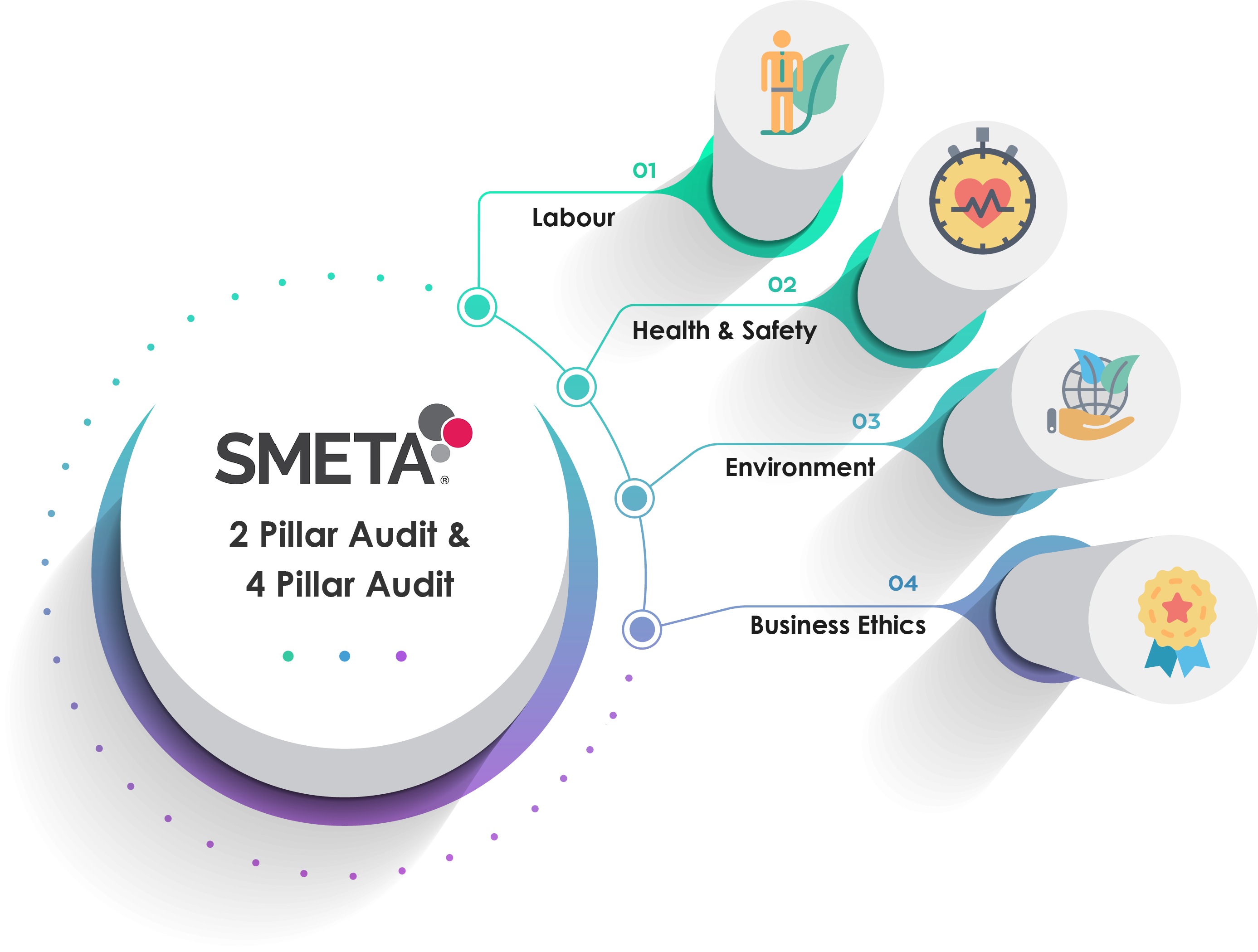
There are many dimensions to a SMETA audit, and they include the following:
- Labour standards
- Health & safety
- Environmental practices
- Business ethics
In simple terms, a SMETA audit tells buyers the following:
“This factory operates ethically and meets international compliance standards.”
Why a SMETA audit is important in Cambodia
Garment manufacturing and exports have recently proliferated in Cambodia. As global brands source their inventory internationally, the demand for ethical business practices and accountability has risen.
As such, the demand for SMETA audits in Cambodia is increasing.
SMETA audits enable factories to:
- Satisfy buyers’ compliance requests
- Establish credibility with international brands
- Minimise the number of audits that are required
- Enhance the factory’s standing
- Increase the capacity to export
For a majority of exporters, SMETA has become a mandatory aspect of their business.
SMETA 2-Pillar vs. 4-Pillar: Which One Does Cambodia Need?
When thinking of starting a SMETA audit, a common question asked by Cambodian factory owners is, “Do we have to get a 2-pillar or a 4-pillar SMETA audit?” The international brand requesting the audit determines the answer, and most of these international brand requests pertain to the 4-Pillar SMETA audit.
SMETA's 2-pillar includes the following:
- Labour Standards: wages, working hours, child labour prevention, freedom of association, and non-discrimination
- Health & Safety: Includes, but is not limited to, items like fire safety, emergency exits, and first-aid procedures
The SMETA 4-Pillar audit includes the 2-Pillar audit and the following additional standards:
- Business Integrity: Includes processes like anti-bribery and data protection, to name a few.
As of now, Cambodian garment factories supplying to European brands have adopted the 4-Pillar SMETA audit to be the new industry standard. The European Union's Corporate Sustainability Due Diligence Directive and related policies are the catalysts for buyers demanding a higher quality of audits from the CSD; hence, they include Cambodia.
GSCS International's audit consultants are available for a review of the buyer’s code of conduct to provide guidance to buyers on the type of audits they are requesting.
Benefits of SMETA Audit for Cambodian Businesses
SMETA audits offer both operational and commercial advantages.
Key Benefits of SMETA Audit
| Benefit | Impact |
| Global Buyer Acceptance | Meets compliance requirements |
| Reduced Audit Fatigue | One audit for multiple buyers |
| Improved Reputation | Builds trust with clients |
| Better Working Conditions | Enhances employee satisfaction |
| Risk Reduction | Identifies compliance gaps early |
| Increased Export Opportunities | Opens new markets |
For Cambodian factories, SMETA is a powerful tool for long-term business growth.
The SMETA Audit Process: Step by Step for Cambodia
If you book an SMETA audit through GSCS International in Cambodia, here are the steps you can expect.
Step 1: Registration on Sedex Platform
Before starting, your factory must be a supplier on the Sedex Platform. If your client is the one that ordered the audit, then they are presumably a Sedex member. After you get the invite, you may need to register yourself, and GSCS International can help.
Step 2: Pre-Audit Self-Assessment Questionnaire (SAQ)
After registration, you must fill a self-assessment questionnaire on the Sedex platform. This step is to find the empty spots that need to be filled before the audit and for the auditors to better understand your factory’s profile.
Step 3: Document Preparation
Your factory must collect and organise the following documents:
- Staff and learners' work agreements
- Wages and overtime enforcement
- Health and safety documentation; fire drills and emergency procedures
- Record and permit the disposal of waste and environmental materials.
- Policies and procedures to prevent business and public sector corruption
GSCS International has a comprehensive document checklist to aid you in this step.
Step 4: Actual Audit
A GSCS-certified auditor, who is trained, will be on your premises in Cambodia, be it a garment factory in Phnom Penh, a footwear factory in Kampong Speu, or a food processing factory anywhere else in the country. The on-site audit will last one to two days, depending on your factory's size.
The auditor will:
- Do a physical inspection of the whole facility.
- Speak to supervisory and HR members of management.
- Gather feedback from employees by means of personal and group interviews that will occur in the express absence of management.
- Go through all the documents we have requested.
- Analyse modern management processes against the new SMETA 7.0 benchmarks
Step 5: Audit Report and Upload to Sedex
After the audit concludes in a few days, the report will be prepared and uploaded to Sedex. All your buyers can access this report, and you won't have to be audited in person, as a SMETA report can be given to as many clients as needed. This is a major SMETA convenience.
Step 6: Corrective Action Plan (CAP)
GSCS International will provide a detailed Corrective Action Plan if the audit reveals non-conformances (NCs). Each NC will include a clear description, root cause analysis, and recommended corrective steps with deadlines. GSCS supports you through the remediation process and can conduct follow-up visits to verify closure of NCs.
SMETA Audit Cost in Cambodia
The cost of a SMETA audit in Cambodia depends on several factors such as factory size, number of workers, and audit scope.
Estimated SMETA Audit Cost
| Factory Size | Estimated Cost |
| Small Factory | $1,500 – $3,000 |
| Medium Factory | $3,000 – $6,000 |
| Large Factory | $6,000 – $12,000+ |
Factors Affecting Cost
- Number of employees
- Number of production lines
- Audit duration
- Compliance readiness
- 2-Pillar vs 4-Pillar audit
Although there is a cost involved, SMETA audit delivers long-term value through increased business opportunities.
Why Choose GSCS International for Your SMETA Audit in Cambodia?
Choosing the right audit partner matters enormously. A SMETA audit is not just a formality; it's a reflection of your factory's commitment to doing business the right way.
Experienced Auditors — Years of social compliance auditing experience across Cambodia's garment, footwear, and manufacturing sectors.
Local Knowledge — Our auditors understand Cambodian labour law and the on-the-ground realities factories face, from Phnom Penh to Kandal and Kampong Cham.
End-to-End Support — From Sedex registration through to NC closure, we stay with you at every step.
Global Recognition — We conduct our audits under internationally recognised standards, ensuring your SMETA report holds significant value for global buyers.
Conclusion
As global buyers continue to prioritise ethical sourcing and transparency, audits like SMETA are becoming essential for suppliers worldwide.
For factories in Cambodia, completing a SMETA audit is not just about compliance; it’s about building trust, improving operations, and unlocking new business opportunities.
By meeting international ethical standards, Cambodian manufacturers can position themselves as reliable and responsible partners in the global supply chain.
With expert guidance from GSCS International, companies in Cambodia can successfully complete SMETA audits and strengthen their presence in international markets.
Frequently Asked Questions
The cost depends on your factory's size, number of workers, and the scope of the audit (2-pillar vs. 4-pillar). Contact GSCS International for a transparent, customized quote.
Typically 1 to 2 days on-site. The full report is usually ready within a few working days after the audit.
Under SMETA 7.0, audit reports older than 24 months are no longer considered robust. Most factories aim to renew every 1 to 2 years.
Yes — this is one of SMETA's key advantages. One audit report uploaded to the Sedex platform can be shared with multiple buyers, reducing audit fatigue significantly.
No factory "fails" a SMETA audit outright. Instead, Non-Conformances are noted and a Corrective Action Plan is issued. You address the issues and can request a follow-up audit to verify closure.