WRAP Audit and Certification in Vietnam: Benefits, Requirements & Cost
Introduction
Vietnam is a global manufacturing leader, especially in garments, textiles, footwear, and apparel. Global brands rely on Vietnamese factories for quality, pricing, and efficiency. However, buyers now demand ethical, safe, and socially responsible workplaces.
With this shift, WRAP Certification is now one of the most valuable credentials for Vietnamese manufacturers entering global markets.
Any production facility, whether garments, textiles, or footwear, can enhance its reputation, build buyer confidence, and unlock export markets by obtaining WRAP Certification in Vietnam.
Many global retailers now require social compliance checks before approving suppliers. Certified factories often gain an edge over non-certified ones.
To help you navigate these developments, this guide explains everything you need to know about Worldwide Responsible Accredited Production (WRAP), including its benefits, certification process, costs, requirements, and why businesses choose GSCS Vietnam as their certification partner.
What Is WRAP Certification and Why Does It Matter for Vietnam?
The Worldwide Responsible Accredited Production (WRAP) program certifies social compliance in the sewn products industry and is the largest program of its kind. Social compliance ensures fair employee treatment and provides safe, lawful factories. More than 700 buyers and retailers around the world recognize WRAP as responsible sourcing.
Vietnam's largest garment and textile export market is the US, accounting for 40% of Vietnam's total export turnover. As a result of this strong exporting market, US retailers, including Walmart and Gap, expect Vietnamese factories to have WRAP certification. Without this certification, factories can expect to be removed from their position as preferred suppliers.
Beyond the US market, the EU's new focus on mandatory due diligence and transparency within the supply chain is also creating expectations of better factory conditions for EU buyers. Gold and Platinum WRAP certification gives EU buyers proof of factory conditions that is both independent and in compliance with the requirements of international standards.
With these shifting expectations, Vietnam's competitive advantage relative to other countries in the region, such as Bangladesh and Cambodia, has improved. WRAP Certification gives Vietnam a further edge because it supports reliability for compliance and quality.
Why WRAP Certification is Important for Vietnam’s Factories
Vietnam’s garment sector still has many opportunities that factory owners have barely started taking advantage of. Here are some reasons why the time is so valuable.
Vietnam is becoming a more popular supplier of apparel for the US over Bangladesh. In October 2025, Vietnam surpassed China as the leading apparel supplier to the US. Because of recent political issues in Bangladesh, many orders have been redirected to Vietnam. Factories with WRAP certification will be the primary beneficiaries of the new orders since buyers do not need to complete a compliance audit.
As recent years have shown, buyers have been working with a smaller number of suppliers. Compliance certification is a major deciding factor on whether a supplier has the continued business of a global brand.
C-TPAT alignment. Because WRAP certification is similar to the requirements of the US Customs-Trade Partnership Against Terrorism (C-TPAT) program, factories with WRAP certification are almost done meeting C-TPAT requirements. This lowers the risk of delays in meeting US Customs.
Now is the time to act. Consider pursuing WRAP certification to secure your factory's place as a preferred supplier, attract global buyers, and retain valuable employees. Seize this opportunity to advance your business in Vietnam's competitive garment market.
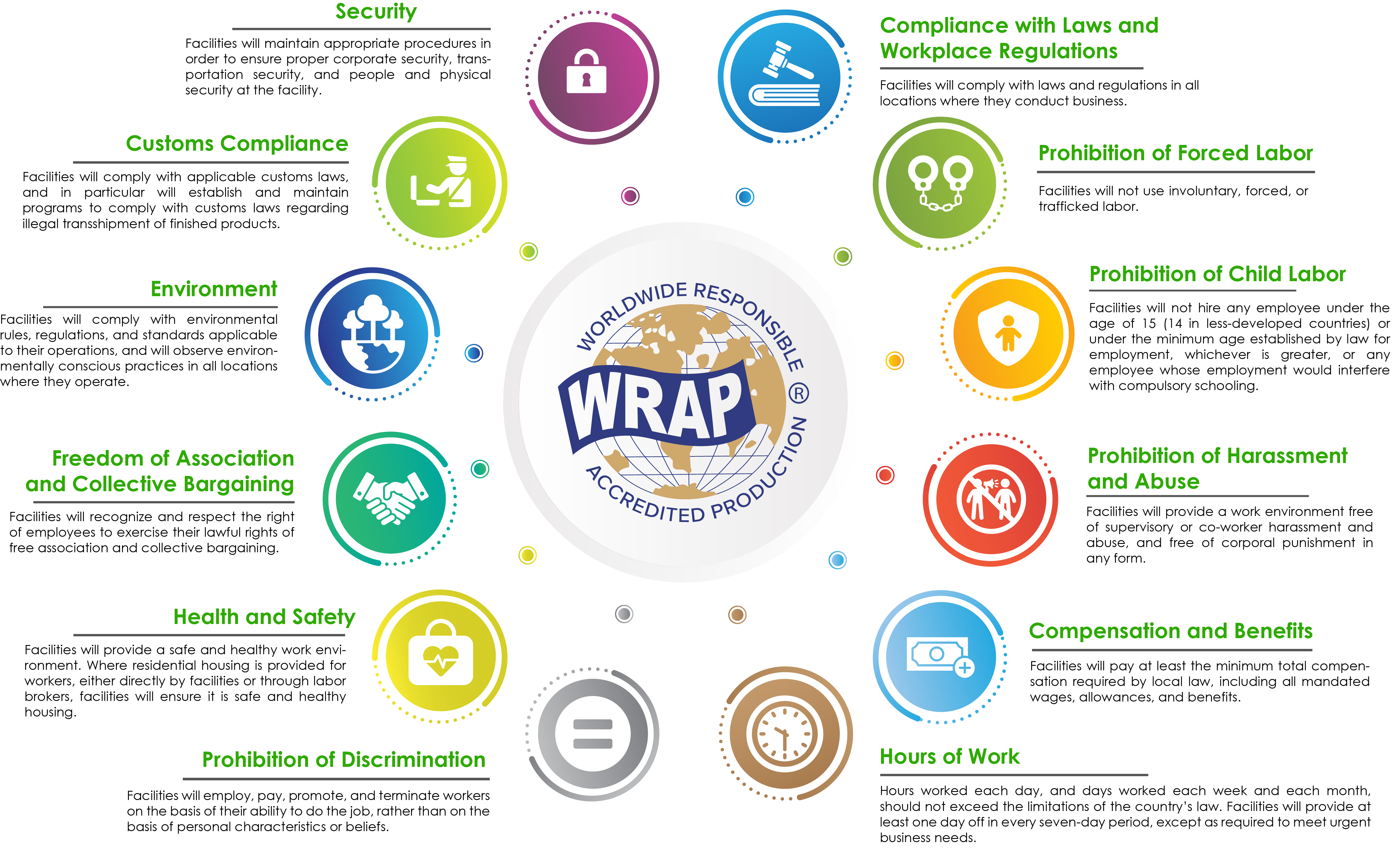
The 12 Principles of WRAP Certification
Every factory seeking WRAP certification is evaluated against 12 core principles. These are not vague guidelines. They are specific, auditable standards that cover every aspect of factory operations.
| Principle | What It Covers |
| No Forced Labor | Employment must be voluntary and free from coercion |
| No Child Labor | All workers must meet legal minimum age requirements |
| No Harassment or Abuse | Workers must be treated with dignity and respect |
| Compensation and Benefits | Wages must meet or exceed legal minimums |
| Hours of Work | Working hours must comply with national labor law |
| Non-Discrimination | Equal opportunity regardless of gender, race, religion, or origin |
| Health and Safety | Safe working conditions and emergency procedures |
| Freedom of Association | Workers can organize and bargain collectively |
| Environmental Compliance | Operations must follow environmental regulations |
| Customs Compliance | Legal import and export practices must be followed |
| Security | Factory premises must be protected against unauthorized access |
| Management Systems | Written policies, training, and monitoring must be in place |
For Vietnamese factories, most of these align closely with the Vietnamese Labor Code (Bộ luật Lao động) and Ministry of Labor, Invalids and Social Affairs (MOLISA) regulations. However, WRAP goes further by requiring documented systems and independent verification, not just paper compliance.
Why Vietnamese Factories Should Get WRAP Certified
Vietnamese garment manufacturing is growing rapidly. Many factory owners are missing new opportunities by not being WRAP certified. Here are key reasons for WRAP's importance now.
Vietnam is in the process of replacing Bangladesh as the 1st exporter of apparel to the United States. In October 2025, Vietnam will become the 1st exporter to the United States, overtaking China. Political issues in Bangladesh have caused many big orders to be sent to Vietnam. WRAP Certified Factories can capture this demand more quickly because buyers do not have to complete a full compliance audit before making an order.
With the disruptive events of the past few years, global brands have been forced to work with a limited pool of suppliers. Compliance Certification has become a big part of the decision-making process to determine who stays on the list of suppliers and who doesn't.
Alignment with C-TPAT. A large portion of the WRAP Certification requirements work in conjunction with the C-TPAT Compliance program. Therefore, factories that are WRAP Certified will also be significantly C-TPAT compliant. This facilitates faster customs clearance and reduces the risk of delays.
Less Worker Turnover. WRAP Certification guarantees improved working conditions and fair wages. Non-certified competitors are often unable to compete; factories have far less turnover. This is very important in the garment manufacturing sector because experienced garment workers are very difficult to find.
Step-by-Step WRAP Certification Process for Vietnam Factories
WRAP certification follows a specific process. Below is what factories in Vietnam can expect.
Step 1: Registration and Application
Factories create a WRAP compliance portal account to register and pay the application fee. WRAP registration fees start at $650 for factories with under 100 workers, and increase to $1,550 and above for larger factories. This application fee goes directly to WRAP and is not included as part of the audit fee paid to the auditing body.
Step 2: Self-Assessment
Factories complete a self-assessment survey covering all 12 WRAP principles. This practice helps identify potential audit gaps. Diligently conducted self-assessments often lead to significantly better audit results.
Step 3: Choosing an Accredited Auditing Body
WRAP has a strict requirement that the formal audit be conducted by an approved independent auditing organisation. GSCS International is a WRAP-accredited auditing body that operates in Vietnam. The auditing partner selected is extremely important, as their local knowledge and expertise, paired with their unique style of communication, will set the stage for how ready the factory is for the audit and how seamless the audit will be.
Step 4: On-Site Audit
GSCS Vietnam team references numerous documents and physically inspects the factory. The On-Site Audit usually takes one to two days. Documents inspected include: payroll records, work hour logs, employment contracts, audit reports, and logs detailing safety procedures, health conditions, and safety training sessions. On-Site Audits include Direct and Confidential interviews with a representative sample of workers.
Step 5: Corrective Action Plan (CAP)
Factories receive a written report of the findings after the on-site audit. Factories also respond to each finding with a corrective action and provide supporting documents to WRAP. A CAP that is well written and formatted demonstrates to WRAP that the factory is serious about compliance and has the capability for management system improvements and sustainability.
Step 6: Certification Issuance
Submission of the CAP and audit report is required for WRAP certification. Certified factories enter WRAP’s global registry, used by international buyers to verify compliance. Certification is awarded as Silver, Gold, or Platinum, based on audit and management system improvements.
WRAP Certification Cost in Vietnam
Certification costs in Vietnam vary based on factory size, number of workers, complexity of operations, and the current state of compliance systems. The estimates below reflect typical ranges for Vietnamese factories
| Factory Size | Estimated Cost Range | Notes |
| Small Factory (up to 150 workers) | $2,000 — $4,500 | Basic audit and certification process |
| Medium Factory (150 — 500 workers) | $4,500 — $9,000 | More detailed audit, multi-function review |
| Large Factory (500+ workers) | $9,000 — $16,000+ | Multi-day audit, complex documentation review |
These figures include the WRAP registration fee and auditing costs. They do not include internal costs such as staff training, document preparation, or any remediation work required before or after the audit. Factories that invest adequately in the pre-audit preparation phase typically have lower total costs because they avoid extended corrective action cycles.
Industries in Vietnam That Benefit from WRAP Certification
WRAP certification is especially valuable for export-oriented industries, including:
- Garment Manufacturing
- Textile Production
- Footwear Manufacturing
- Apparel Exporters
- Fashion Supply Chains
- Accessories Manufacturing
- Bags and Luggage Production
- Home Textile Manufacturers
- Consumer Goods Factories
Any production facility supplying international markets can benefit from WRAP certification.
Conclusion
This is a pivotal time for Vietnam’s garment industry. Leading brands are increasingly placing orders. Buyers now demand higher compliance standards. Achieving WRAP Certification is crucial for factories to build enduring client relationships.
Certification is more than just having a passing score for an audit. Factories need to develop a more robust system. These systems should help safeguard the workers, along with a reduction in operational risks. This will instil confidence in buyers to foster a more lasting business relationship.
GSCS Vietnam offers advanced audit methodologies and expertise in local laws and practical guidance for factories during the WRAP Journey. GSCS Vietnam supports your factory through its first WRAP Certification or when upgrading from Silver to Gold Certification.
Frequently Asked Questions
WRAP certification is an internationally recognized social compliance standard that verifies a factory in Vietnam operates ethically, treats workers fairly, maintains safe conditions, and follows applicable laws. It is issued by WRAP, a globally recognized accreditation body based in the United States.
Garment factories, textile manufacturers, footwear producers, accessories makers, and any export-oriented factory supplying to US or international brands typically need WRAP certification. It is especially important for factories supplying American retailers, as many require it as a condition of doing business.
Costs generally range from approximately $2,000 for smaller factories to $16,000 or more for large, complex operations. The total cost depends on factory size, audit scope, and the level of compliance preparation required.
WRAP is primarily recognized by American buyers, but a growing number of European brands accept it as part of their supplier qualification process. For EU-specific requirements, SMETA or SA8000 may be additionally relevant. GSCS Vietnam can advise on which combination best meets your specific buyer requirements.
A factory does not simply pass or fail WRAP. Auditors identify findings, and the factory submits a corrective action plan. If findings are minor, certification can still be issued with corrective actions noted. More serious findings require documented remediation before certification is granted. GSCS Vietnam guides factories through the CAP process to ensure the best possible outcome.